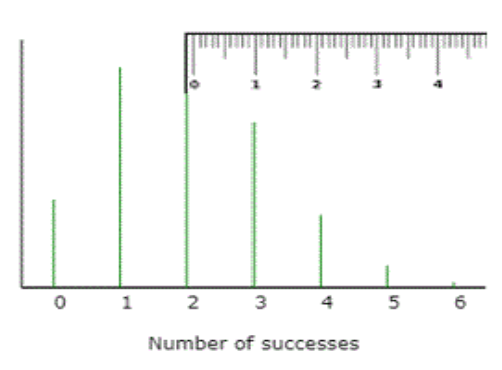
How many hits did you get?
Section 2.3 Investigation 1.3: Are You Clairvoyant?
A standard test for extra-sensory perception (ESP) asks subjects to identify which of five symbols (e.g., circle, plus, square, diamond, waves) is on the front of a card, viewed by the experimenter but not the subject. The experimenter concentrates on the symbol and a βhitβ is when the subject correctly identifies the symbol being viewed by the experimenter. The subject is given several trials, with the viewed symbol randomly determined for each of the trials, with no discernible pattern.
ESP Test Symbols:

Online tests are available as well. Go to www.psychicscience.org/esp3.aspx to test your clairvoyance (predicting whatβs about to happen rather than reading what someone else is thinking). Scroll down to Advanced ESP Test and review the 5 possible symbols, then press Start. Click on the card that you believe is about to be shown. Repeat for 10 rounds, keeping tracking of the number of hits in your first 10 attempts.
Checkpoint 2.3.1. Conduct the ESP Test.
Checkpoint 2.3.2. Identify Sample and Variable.
Identify the sample and variable for this random process.
Checkpoint 2.3.3. Binomial Random Process.
Do you consider it reasonable to model your observations as coming from a binomial random process? Explain your reasoning.
Hint.
Terminology Detour: Statistic vs. Parameter.
In analyzing data, it is important to differentiate between a statistic and the parameter. The observed statistic is a (known) numerical value that summarizes the observed results, whereas the parameter is the same numerical summary but applied to the underlying random process that generated the data. The value of the statistic is what we observe in the study, whereas the value of the parameter is rarely known.
In Investigation 1.1, the statistic could be either the number (14) or the proportion (0.875) of infants who chose the helper toy. The parameter would then be the long-run probability of an infant picking the helper toy. In the case of a binomial random variable, we will use the symbol \(\pi\) (lower case Greek letter for βpβ) to represent this unknown process probability.
Checkpoint 2.3.4. Identify the Parameter.
Identify (in words) the parameter of interest for this study.
Hint.
Checkpoint 2.3.5. Parameter Symbol.
What symbol will we use to represent this parameter?
- \(\hat{p}\)
- This is the symbol for the sample proportion (statistic), not the population parameter.
- \(\pi\)
- Correct! We use \(\pi\) to represent the probability of success in a binomial process.
- \(\mu\)
- This is the symbol for a population mean, not a probability.
- p
- While p is sometimes used for probability, we use the Greek letter \(\pi\) for the process probability parameter.
Checkpoint 2.3.6. State the Null Hypothesis.
Checkpoint 2.3.7. State the Alternative Hypothesis.
Hint.
Checkpoint 2.3.8. Simulation Method.
Assume the null hypothesis is true and let the random variable \(C\) denote the number of correct identifications (hits) in 10 attempts. If we were to simulate this random process, could we toss coins? If not, suggest another way we could generate simulated results assuming the null hypothesis to be true. (e.g., what would you want an applet to do?)
Hint.
Solution.
We can model \(C\) with the binomial distribution:
-
Each trial has two outcomes: correct match or not
-
The trials are independent (the cards are shuffled in between attempts and the symbols are placed at random with no patterns from trial to trial)
-
There are a fixed number of attempts (\(n = 10\))
-
The probability of success (if someone is guessing) is the same for each trial (\(= 0.20\) if using 5 cards each trial). We arenβt changing the number of cards or anything else from trial-to-trial.
We canβt toss a coin because we are not assuming 50/50 for success/failure. To model 0.20 we could use spinners.
Checkpoint 2.3.9. Null Distribution Predictions.
Where do you think your null distribution will be centered? What are the largest and smallest possible values for the number of correct identifications in 10 attempts? What are the largest and smallest values you think you will see in the simulation?
Hint.
Checkpoint 2.3.10. Carry Out the Simulation.
In the One Proportion Inference applet, specify the values for \(\pi\) and \(n\text{.}\) Carry out one repetition of the simulation. Explain the simulation process in your own words.
Checkpoint 2.3.11. Theoretical Mean and Standard Deviation.
Then check the Exact Binomial box to see the null distribution after infinitely many repetitions. Press the Reset button to remove the one simulated result and check the Summary Statistics box. What are the theoretical values for the mean and standard deviation of the null distribution?
Mean =
Std Dev =
Hint.
Binomial Distribution Formulas.
It can be shown that when \(X\) is Binomial(\(n\text{,}\) \(\pi\)), the expected value is \(E(X) = n \times \pi\) and the variance is \(V(X) = n\pi(1 - \pi)\text{.}\) (See Exploration B for more discussion of expected value and variance of a random variable.)
Checkpoint 2.3.12. Verify the Calculations.
Verify these calculations match the applet output and remember that the standard deviation is the square root of the variance.
Checkpoint 2.3.13. Result in the Tail?
Was your statistic from Checkpoint 3.77 (your number of hits) in the direction specified by the alternative hypothesis? If it was, is it in one of the tails (outer edges) of the null distribution from Checkpoint 3.86?
Hint.
If your observed number of successes was below the mean, then you can conclude that your data do not provide evidence in favor of the alternative hypothesis and you should not start your own psychic hotline! But if your result was above the mean, then we would like to measure the strength of evidence against the null hypothesis. You have already seen how to do that using a p-value.
Checkpoint 2.3.14. Explore p-value Threshold.
Use the applet to explore how many hits a subject would need in 10 attempts for the p-value to be below 0.05.
An Alternative Measure of Rareness.
As an alternative to the p-value, another measure of where an observation falls in a distribution is βhow many standard deviationsβ it is from the mean of the distribution.
A number line showing distances from the null hypothesis mean:

\begin{equation*}
\frac{\text{observed number of hits} - \text{expected value}}{\text{standard deviation}}
\end{equation*}
Checkpoint 2.3.15. Standardize Your Result.
How many standard deviations was your observed result from the expected value for the binomial distribution?
Hint.
This calculation is often referred to as standardizing the statistic.
Again, there are no hard and fast rules for what constitutes a large value here, but generally, when we have a fairly symmetric distribution, values more than 2 standard deviations above or below the expected value (mean) are considered extreme.
Checkpoint 2.3.16. Standardizing 5 Hits.
How many standard deviations from the mean (expected value) would 5 hits be?
Hint.
Solution.
A standardized statistic of 1 means that the sample result is one standard deviation above the mean of 2. Because the SD is 1.265, 1 SD above the mean is at \(2 + 1.265 = 3.265\text{.}\) Rounding to the nearest whole number, that would correspond to 3 correct identifications. (Or you could solve: \((x - 2)/1.265 = 1\) to find \(x = 3.265\text{.}\))
Checkpoint 2.3.17. Distribution for 25 Attempts.
Suppose you donβt know whether or not someone is clairvoyant and you plan to give the person 25 attempts. What are the theoretical expected number and standard deviation for the random variable \(C\text{,}\) the number of hits when \(n = 25\) assuming they are just guessing each time? How do they compare to the values you found in (j)?
Hint.
How many hits would someone need to get correct in 25 attempts to convince you they arenβt simply guessing? Letβs consider two ways to decide.
Checkpoint 2.3.18. Approach 1: P-value Threshold.
Approach 1: What value for \(c\) would give you a probability below 0.05 of obtaining that many or more hits? In other words, what is the smallest value of \(c\) so \(P(C \geq c) < 0.05\text{?}\)
Checkpoint 2.3.19. Approach 2: Standard Deviations.
Approach 2: What is the smallest value of \(c\) that is at least 2 standard deviations from the expected value?
Checkpoint 2.3.20. Compare the Two Approaches.
How do your answers for these two approaches compare?
Hint.
Solution.
It is not a coincidence that the value of 9 appears in both and is close to the expected value + 2 SD. It turns out that with a βlarge enoughβ sample size, if a standardized statistic is about 2 SD from the mean, the p-value will be close to 0.05. We will develop this idea much more carefully when we turn to the normal approximation to the binomial.
Checkpoint 2.3.21. Test with Four Symbols.
Suppose you changed the test to use only 4 symbols. Does this change the expected number or standard deviation for the number of hits when a subject is guessing? How many would someone need to identify correctly to convince you they could perform better than guessing in the long-run?
Hint.
Solution.
This would increase the probability of a correct guess to 0.25, and so the probability model would need to change as well. If there are only 4 cards, the probability of a correct guess increases to 0.25. So, with 25 attempts, the expected value would be \(25(0.25) = 6.25\) with an SD of \(\sqrt{25(0.25)(0.75)} = 2.17\text{.}\) So \(6.25 + 2(2.17) = 10.59 \approx 11\text{.}\) Notice that this βcutoffβ value went up (10 or 11 vs. 9). This is because guessing is more likely to do well so we need more evidence that someone is not guessing. Also, using the applet, \(P(C \geq 10) = 0.097\) and \(P(C \geq 11) = 0.044\text{.}\)

Summary.
The number of correct answers in 25 attempts, for someone who is guessing, can be modeled with a binomial distribution (assuming the probability of a correct answer is 0.20 each time and there is no pattern from attempt to attempt). In this case, the hypothesized value for the probability of βsuccessβ will be 0.20 rather than 0.5 due to the five cards to choose from, which we could model with spinners rather than coin tosses. If someone is simply guessing, in the long run they will guess correctly by chance alone 20% of the time. This means that if we give someone 25 attempts, we expect them to answer correctly \(0.20 \times 25 = 5\) times (on average, in the long run), with a standard deviation of \(\sqrt{25(0.20)(0.80)} = 2\) hits in 25 attempts. Keep in mind that the βstatistical significanceβ of an outcome will depend on both the mean and the standard deviation of the null distribution. In this case, someone would need 9 or more hits to be more than 2 standard deviations above the mean, which corresponds to a p-value of 0.048. (It is not a coincidence that the 0.05 cut-off gives very similar results to the 2SD cut-off.)
Subsection 2.3.1 Practice Problem 1.3A
Checkpoint 2.3.22. Six Symbols: Distribution Changes.
Suppose the test had consisted of 6 symbols instead of 5 (with \(n = 25\) still). How will that change the binomial distribution? [You should comment on both the mean and the standard deviation.]
Checkpoint 2.3.23. Six Symbols: Surprising Outcome.
Would an outcome of 9 correct guesses be more or less surprising in this case (vs. 5 symbols)?
Checkpoint 2.3.24. Ten Symbols.
What about 10 symbols? What are the mean and standard deviation of the binomial distribution? Would an outcome of 9 or more correct identifications be more or less surprising than with 5 symbols?
Checkpoint 2.3.25. Shape of Distribution.
How does the shape of the binomial distribution change as you lower \(\pi\text{?}\) Explain why.
Subsection 2.3.2 Practice Problem 1.3B
Return to the wolf (Yukon). In another study, Yukon correctly understood a communicative cue in 7 of 8 attempts.
Checkpoint 2.3.26. Parameter and Statistic.
Identify (in words) the parameter and statistic in that study.
Checkpoint 2.3.27. Standardized Result.
How many standard deviations did the observed statistic fall above the expected value assuming Yukon picks equally between the two containers regardless of the cue in the long run?
Checkpoint 2.3.28. Surprising Outcome?
Would her performance be considered a surprising outcome when the null hypothesis is true? Explain.
Return to the infants choosing a helper toy over a hinderer toy 14 times out of 16 choices.
Checkpoint 2.3.29. Infant Study: Parameter and Statistic.
Identify (in words) the parameter and statistic in that study.
Checkpoint 2.3.30. Infant Study: Standardized Result.
How many standard deviations did the observed statistic fall above the expected value assuming infants choose equally between the two types of toys?
Checkpoint 2.3.31. Infant Study: Time Variable.
In the infant study, researchers also looked at the amount of time the infants spent watching the two videos (to see whether one captured their attention more than the other). Identify a possible parameter of interest for this new variable.
Subsection 2.3.3 Practice Problem 1.3C
Suppose you select 100 students at your school to estimate the proportion who prefer Coke to Pepsi.
Checkpoint 2.3.36. Average Number of States.
Suppose you want to estimate the average number of states visited by students at your school. Define the parameter of interest.
You have attempted of activities on this page.