Section 15.2 Investigation 3.6: Is Yawning Contagious?
In this investigation, you will learn how to calculate an "exact" p-value for the randomization distribution you just simulated.
Exercises 15.2.1 The Study
The folks at MythBusters, a popular television program on the Discovery Channel, investigated whether yawning is contagious by recruiting fifty subjects at a local flea market and asking them to sit in one of three small rooms for a short period of time. Video snippet
For some of the subjects, the attendee yawned while leading them to two of the rooms (planting a yawn "seed"), whereas for the other subjects the attendee did not yawn while leading to a third room. As time passed, the researchers watched (via a hidden camera) to see which subjects yawned.
2. State Hypotheses.
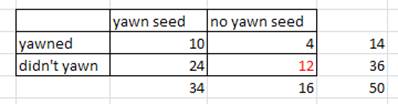
In the study they found that 10 of 34 subjects who had been given a yawn seed actually yawned themselves, compared with 4 of 16 subjects who had not been given a yawn seed.
3. Create Two-Way Table.
Create a two-way table summarizing the results, using the explanatory variable as the column variable.
| Outcome \ Treatment | Yawn Seed | No Yawn Seed | Totals |
|---|---|---|---|
| Yawned | |||
| Did not yawn | |||
| Totals |
Solution.
| Outcome \ Treatment | Yawn Seed | No Yawn Seed | Totals |
|---|---|---|---|
| Yawned | 10 | 4 | 14 |
| Did not yawn | 24 | 12 | 36 |
| Totals | 34 | 16 | 50 |
4. Design Simulation.
Open the Analyzing Two-way Tables applet.
-
Paste in the raw data and press Use Data or enter the titles and counts of a two-way table and press Use Table. (Or check the 2×2 box and enter the cell values and headers). Or use the version below.
-
Select GroupA Successes as the Statistic.
-
Check the Show Shuffle Options box.
-
Set Number of Shuffles to 1000.
-
Press Shuffle.
5. Describe Randomization Distribution.
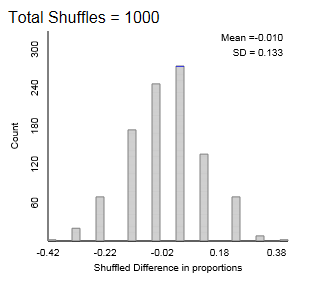
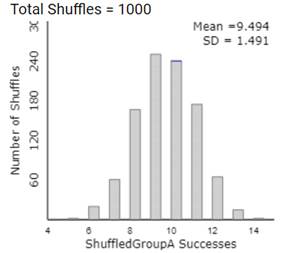
Briefly describe this randomization (null) distribution: What is its shape? What is the mean? What is the standard deviation?
-
Specify the observed number of successes in the Count Samples box.
-
Then indicate whether the research conjecture expected a larger or smaller number of successes in the seed treatment by choosing Greater Than or Less Than from the pull-down menu.
-
Then press the Count button.
6. Estimate p-value.
Report your estimate of the p-value:
Exact p-value.
The simulations you have conducted in Investigations 3.5 (Dolphin Therapy) and above approximated the p-value for two-way tables arising from random assignment by assuming the row and column totals are fixed. In this case, the probability of obtaining a specific number of successes in one group can be calculated exactly using the hypergeometric probability distribution. (We used the independent binomial distributions with the teen hearing loss study, where we wanted to sample separately from two populations and the overall number of successes was not fixed in advance.)
Keep in mind, that under the null hypothesis, we are assuming the group assignments made no difference and that there would be 14 successes ("yawners") and 36 failures ("non-yawners") between the two groups regardless.
Because the random assignment makes every configuration of the subjects between the two groups equally likely, we determine the probability of any particular outcome for the number of yawners and non-yawners by first counting the total number of ways to assign 34 of the subjects to the yawn-seed group (and 16 to the no-yawn-seed group) in the denominator. The numerator is then the number of ways to get a particular set of configurations for that group, such as those consisting of 10 yawners and 24 non-yawners.
7. Total Ways to Assign.
How many ways altogether are there to randomly assign these 50 subjects into one group of 34 (yawn-seed group) and the remaining group of 16 (no-yawn-seed group)?
Hint.
8. Ways to Obtain Observed Configuration.
Now consider the 14 successes and the 36 failures.
How many ways are there to randomly select 10 of the successes?
Successes:
How many ways are there to randomly assign 24 of the failures to be in the yawn seed group?
Failures:
How should you combine these two numbers to calculate the total number of ways to obtain 10 successes and 24 failures in the yawn-seed group, the configuration that we observed in the study?
Total:
9. Calculate Exact Probability.
To determine the exact probability that random assignment would produce exactly 10 successes and 24 failures into the group of 34 subjects, divide your calculation in Question 8 by your calculation in Question 7.
Hint.
10. Is this the p-value?
Hypergeometric Distribution.
The probability of obtaining \(k\) successes in Group A, with \(n\) observations, when sampled from a two-way table with \(N\) observations, consisting of \(M\) successes and \(N - M\) failures is:
\begin{equation*}
P(X = k) = \frac{C(M, k) \times C(N - M, n - k)}{C(N, n)}
\end{equation*}
where \(C(N, n) = \frac{N!}{n!(N - n)!}\) is the number of ways to choose \(n\) items from a group of \(N\) items, and \(X\) represents the number of successes randomly selected for group A. \(X\) is a hypergeometric random variable. Also note \(E(X) = n(M/N)\) and \(SD(X) = \sqrt{n(M/N)(1 - M/N)(N - n)/(N - 1)}\text{.}\)
In this study, we had \(N = 50\) subjects and we defined yawning to be success so \(M = 14\text{.}\) We also arbitrarily chose to focus on the yawn-seed group, so \(n = 34\text{.}\) This calculation works out the same if you had defined "not yawning" to be a success and/or if you had focused on the 16 people in the no-yawn-seed group. You just need to make sure you count consistently.
We will continue to define the p-value to be the probability of obtaining results at least as extreme as those observed in the actual study. Because we expected more yawners in the yawn-seed group, the p-value is the probability of randomly assigning at least 10 of the yawners in the yawn-seed group.
So far you have found \(P(X = 10) = C(14, 10) \times C(36, 24) / C(50, 34) = 0.2545\text{.}\)
11. Calculate Additional Probabilities.
12. Exact p-value and Interpretation.
Sum all five probabilities together (including P(X = 10)) to determine the exact p-value for the yawning study. How does this p-value compare to the empirical p-value from the applet simulation? Write a one or two sentence interpretation of this p-value.
Exact p-value:
Comparison:
Interpretation:
Solution.
Exact p-value: 0.254 + 0.1708 + 0.0702 + 0.0158 + 0.0015 = 0.5128
Comparison: similar to simulation
Interpretation: P(X ≥ 10), probability of 10 or more successes by random assignment alone (assuming no effect from the seed). If the yawn seed has no effect, the probability of finding 10 or more of 34 yawners in the seeded group when 50 subjects are randomly assigned to seeded and no-seed groups is 0.5128.
Definition: Fisher’s Exact Test.
Using the hypergeometric probabilities to determine a p-value in this fashion for a two-way table is called Fisher’s Exact Test, named after R. A. Fisher.
Technology Detour – Calculating Hypergeometric Probabilities (Fisher’s Exact Test).
Use technology to calculate hypergeometric probabilities (Fisher’s Exact Test) for two-way tables. You need to specify the total number of observations (\(N\)), the number of successes (\(M\)), and the sample size (\(n\)).
Hint 1. Applet Instructions
In the Analyzing Two-way Tables applet:
-
Choose the 2×2 box to enter the cell values and headers for a two-way table
-
Enter the two-way table (and row and column headers)
-
Press Use Table
-
Check the box for Show Fisher’s Exact Test in the lower left corner
-
A check box will appear for determining the two-sided p-value
Example applet output:

Hint 2. R Instructions
The
iscamhyperprob function takes the following inputs:
-
k, the observed value of interest (or the difference in conditional proportions, assumed if value is less than one, including negative) -
total, the total number of observations in the two-way table -
succ, the overall number of successes in the table -
n, the number of observations in "group A" -
lower.tail, a Boolean which is TRUE or FALSE
For example:
Example R output:

Hint 3. JMP Instructions
Using the Distribution Calculator:
-
Choose Hypergeometric from the Distribution menu
-
Specify the values of Population Size = table total, Number of Items = total number of successes, Sample Size = group 1 total
-
Select Input quantiles and compute probabilities
-
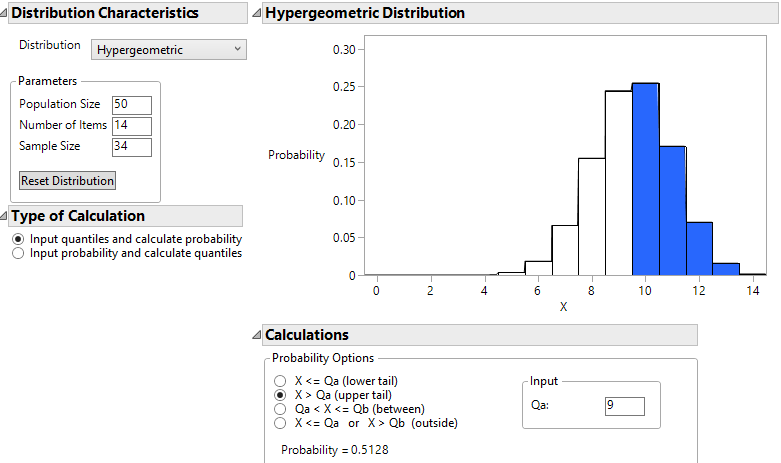
Specify the upper tail probability and enter Qa = number of successes in "group A" (minus 1)
Example JMP output:
13. Exact p-value.
Calculate this hypergeometric probability using technology (using one of the methods above). Did the technology confirm your by-hand calculation?
-
Yes, the technology confirmed the by-hand p-value.
-
Correct! The technology should give the same exact p-value.
-
No, the technology gave a noticeably different p-value.
-
Double-check your technology inputs: N = 50, M = 14, n = 34, k = 10, upper tail. You should get 0.5128.
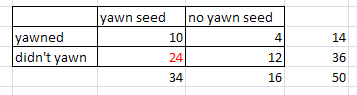
14. Alternative Setup - Not Yawning.
15. Alternative Setup - No Seed Group.
Discussion.
You should see that there are several equivalent ways to set up the probability calculation. Make sure it is clear how you define success/failure and which group you are considering "group A." This will help you determine the numerical values for \(N\text{,}\) \(M\text{,}\) and \(n\) in the calculation.
Below is a graph of the Hypergeometric distribution with \(N = 50\text{,}\) \(M = 14\text{,}\) and \(n = 34\text{.}\)
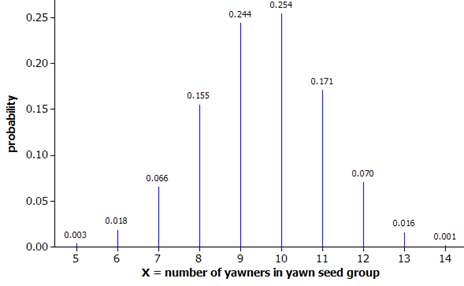
Using probability rules, you can show that the expected value of this distribution is \((14/50) \times 34 = 9.52\) yawners in yawn seed group and the standard deviation of the probability distribution is the square root of \(n \times (M/N) \times (N – M)/N \times (N – n)/(N – 1) = 1.496\) yawners.
16. Compare to Simulation.
17. MythBusters Conclusion.
On the MythBusters program, the hosts concluded that, based on the observed difference in conditional proportions and the large sample size, there is "little doubt, yawning seems to be contagious." Do you agree?
18. Generalizability.
To what population are you willing to generalize these results? Explain your reasoning.
Study Conclusions.
With a large p-value of 0.513 (Fisher’s Exact Test), we do not have any evidence that the difference between the two groups (with and without yawn seed) was created from something other than the random assignment process. If there was nothing to the theory that yawning is contagious, by "luck of the draw" alone, we would expect 10 or more of the yawners to end up in the yawn seed group in more than 50% of random assignments. Although the study results were in the conjectured direction, the difference between the yawning proportions was not large enough to convince us that the probability of yawning is truly larger when a yawn seed is planted. The researchers could try the study again with a larger sample size to increase the power of their test. The researchers also may want to be cautious in generalizing these results beyond the population of volunteers at a local flea market or how naturalistic the setting of leading individuals to a small room to wait is.
Subsection 15.2.2 Practice Problem 3.6A
Checkpoint 15.2.1. Evidence Against Contagious Yawning.
For the MythBusters study (p-value > 0.5), is it reasonable to conclude from this study that we have strong evidence that yawning is not contagious? Explain.
Checkpoint 15.2.2. Sample Size and Power.
Explain, in this context, what is meant in the Study Conclusions box by "the researchers could try the study again with a larger sample size to increase the power of their test" and why that is a reasonable recommendation here.
Checkpoint 15.2.3. Hypergeometric vs Binomial.
To calculate the p-value here, why are we using the hypergeometric distribution instead of the binomial distribution?
Subsection 15.2.3 Practice Problem 3.6B
Reconsider the Dolphin Therapy study (Investigation 3.5).
| Outcome \ Treatment | Dolphin Therapy | Control Group | Total |
|---|---|---|---|
| Showed substantial improvement | 10 | 3 | 13 |
| Did not show substantial improvement | 5 | 12 | 17 |
| Total | 15 | 15 | 30 |
Continue to focus on the number of improvers randomly assigned to the dolphin group, and represent this value by \(X\text{.}\)
Checkpoint 15.2.4. Hypergeometric Parameters.
Checkpoint 15.2.5. Setup for Exact p-value.
Checkpoint 15.2.6. Calculate Exact p-value.
Checkpoint 15.2.7. Double the Sample Size.
Suppose that the dolphin study had involved twice as many subjects, again with half randomly assigned to each group, and with the same proportion of improvers in each group. Determine the exact p-value in this case, and comment on whether/how it changes from the p-value with the real data. Explain why this makes sense.
Subsection 15.2.4 Practice Problem 3.6C
Checkpoint 15.2.8. Alternative Setup - Not Yawning.
Checkpoint 15.2.9. Technology Calculation - Non-yawners.
Checkpoint 15.2.10. No Seed Group Probability.
Suppose I want to find the probability of 4 or fewer yawners in the No Seed group. Identify the values of \(N\text{,}\) \(M\text{,}\) \(n\text{,}\) and \(k\text{.}\) Use technology to calculate the probability of 4 or fewer yawners in the No Seed group using the hypergeometric distribution. (Include readable output.)
Checkpoint 15.2.11. Importance of Blinding.
In the Yawning study, why was it important that the subjects didn’t know what the study was about when they were led into the room?
Checkpoint 15.2.12. Unequal Sample Sizes.
In the Yawning study, is it a problem that the sample sizes for the Yawn seed and the No Yawn seed group aren’t equal? Explain.
You have attempted of activities on this page.

