Section 10.1 Investigation 2.7: Water Oxygen Levels
Exercises 10.1.1 The Study
Scientists often monitor the "health" of water systems to determine the impact of different changes in the environment. For example, Riggs (2002) reports on a case study that monitored the dissolved oxygen downstream from a commercial hog operation. There had been problems at this site for several years (e.g., manure lagoon overflow), including several fish deaths in the previous three years just downstream of a large swale through which runoff from the hog facility had escaped.

The state pollution control agency decided to closely monitor dissolved oxygen downstream of the swale for the next three years to determine whether the problem had been resolved. In particular, they wanted to see whether there was a tendency for the dissolved oxygen level in the river to be less than the 5.0 mg/l standard. Sampling was scheduled to commence in January of 2000 and run through December of 2002. The monitors took measurements at a single point in the river, approximately six tenths of a mile from the swale, once every 11 days.
2. Assess sampling method.
Because the dissolved oxygen measurements were taken in the same location at fixed time intervals, would you consider this a simple random sample? Do you think the sample is likely to be representative of the river conditions? Explain.
Definition: Systematic Sample.
A systematic sample selects observations at fixed intervals (e.g., every 10th person in line). If the initial observation is chosen at random and there is no structure in the data matching up to the interval size (e.g., every 7th day), then such samples are generally assumed to be representative of the population. In fact, we will often simplify the analysis by assuming they behave like simple random samples.
3. Describe distribution.
Aside: Descriptive Statistics applet.
Examine the data from the first year in
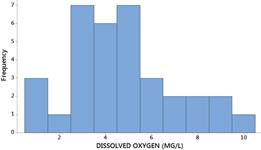
WaterQuality.txt. Describe the shape, center, and variability of the distribution. In particular, how do the mean and median compare? Do these data appear to be well-modelled by a normal distribution? Is there a tendency for the dissolved oxygen levels to be below the standard?
4. State hypotheses.
5. Assess validity of t-test.
Is the one-sample t-test likely to be valid for these data? Explain why or why not.
Alternative analysis: Proportion non-compliant.
An alternative analysis involves recoding the observations as "compliant" and "not compliant." If we say a measurement is non-compliant when the dissolved oxygen is below 5.0 mg/l, how many non-compliant measurements do we have in this data set?
6. Calculate proportion non-compliant.
7. Test proportion non-compliant.
Aside: One Proportion applet.
Carry out a test for deciding whether the proportion of measurements that fall below 5.0 mg/l is statistically significantly larger than 0.50 (one-half).
Solution.
Let \(\pi\) refer to the probability of a non-compliant measurement in this river.
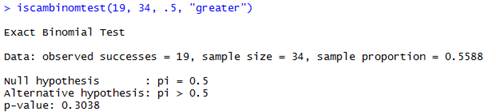
Assuming independent observations (systematic sample) and a constant probability of success (under the null \(\pi = 0.50\) for this observation period), we can model this with the binomial distribution (\(n = 34\) and \(\pi = 0.50\)).
\(P(X \geq 19) \approx 0.3038\text{.}\)
We do not have a small p-value, so we do not have evidence that the probability of non-compliance exceeds 0.50.
8. Interpret median.
9. Compare to t-test.
10. Alternative criterion.
The researchers actually wanted to decide whether the river was non-compliant more than 10% of the time. How would that change your analysis in Question 7 and would the p-value be larger or smaller?
Study Conclusions.
Both the mean (not shown) and of the median indicate that dissolved oxygen in this river tended to be below the 5.0 mg/l that was cited as the "action level." Although we don’t have statistically significant evidence that the long-run median DO level is below 5.0 mg/l (binomial p-value \(\approx 0.30\)), the researchers actually wanted to engage in remedial action if the river was found to be in non-compliance significantly more than 10% of the time. The exact binomial probability of observing 19 or more non-compliant values from a process with a 0.10 chance of non-compliance is \(4.16 \times 10^{-11}\text{,}\) leaving "little doubt that the 10% non-compliant criterion was exceeded at the monitoring site during 2000."
Discussion: Sign Test.
When we use 0.50 as the hypothesized probability of success and we count how many of our quantitative observations exceed some pre-specified level, this is called the sign test and corresponds to a test of whether the population median equals that pre-specified level. The sign test can be advantageous over the t-test if the technical conditions for the t-test are not met (e.g., skewness in sample, not a large sample size). However, although this procedure focuses on how often you are above or below that level, it does not provide information about how far above or below as a confidence interval for the mean could.
Subsection 10.1.2 Practice Problem 2.7
Return to Practice Problem 2.2A and the
30seconds.txt data. Carry out a test to determine whether there is convincing evidence that the median student estimate of 30 seconds differs from 30.
Checkpoint 10.1.1. Does the median differ from 30 seconds?
Carry out the sign test for the 30 seconds data. (State your hypothesis, statistic and/or standardized statistic, and p-value.)
You have attempted of activities on this page.

