Often a given problem can be solved in more than one way. A particular method may be chosen out of convenience, personal preference, or perhaps necessity. Ultimately, it is good to have options.
The previous section introduced the Disk and Washer Methods, which computed the volume of solids of revolution by integrating the cross-sectional area of the solid. This section develops another method of computing volume, the Shell Method. Instead of slicing the solid perpendicular to the axis of rotation creating cross-sections, we now slice it parallel to the axis of rotation, creating “shells.”
Consider Figure 7.3.2, where the region shown in Figure 7.3.2(a) is rotated around the \(y\)-axis forming the solid shown in Figure 7.3.2(b). A small slice of the region is drawn in Figure 7.3.2(a), parallel to the axis of rotation. When the region is rotated, this thin slice forms a cylindrical shell, as pictured in Figure 7.3.2(c). The previous section approximated a solid with lots of thin disks (or washers); we now approximate a solid with many thin cylindrical shells.
Graph of the function \(y=\frac{1}{1+x^2} \text{.}\) The curve begins at the point \((0,1)\text{.}\) The curve then decreases until it meets the horizontal line \(x=1\) where it stops at the point \((1,\frac12) \text{.}\) The entire area enclosed by \(y=\frac{1}{1+x^2} \text{,}\)\(x=0 \text{,}\)\(x=1 \) and \(y=0 \) is shaded. In other words, the region consists of the area lying below the curve and above the \(x\)-axis A vertical red rectangular slice with a base having an approximate length of \(0.5 \) coming up from approximately the point \((0.5,0) \) reaches up to meet the curve. This rectangle when rotated about the \(y\)-axis will form a cylindrical shell in the following figures.
A three dimensional diagram of the area enclosed by the curve \(y=\frac{1}{1+x^2} \text{,}\) and the lines \(x=0 \text{,}\)\(x=1 \) and \(y=0 \) rotated about the \(y\)-axis. The base of this shape is a unit circle lying on the \(xz\) plane. This unit circle comes up from \(y=0\) to \(y=0.5\) creating a solid cylinder. The region above \(y=0.5\) forms a shape which looks like a perfectly symmetrical mountain whose peak occurs at the point \((0,1,0)\text{.}\) The space below this region above the \(y\)-axis is contained in the shape which comes from rotating the curve.
The red rectangle from figure (a) is rotated 360 degrees about the \(y\)-axis, creating a cylindrical shell. Two circles, one of radius \(0.5\) and one of radius \(0.6\) are drawn on the \(xz\)-plane. The area between the circles is shaded, creating a circular disc in the \(xz\)-plane. The disc then goes up from \(y=0 \) until it meets the curve \(y=\frac{1}{1+x^2} \text{,}\) which creates the cylindrical shell. Adding up many of these cylindrical shells will then allow us to approximate the volume of the solid described in the previous images.
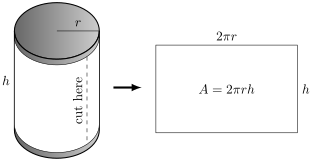
To compute the volume of one shell, first consider the paper label on a soup can with radius \(r\) and height \(h\text{.}\) What is the area of this label? A simple way of determining this is to cut the label and lay it out flat, forming a rectangle with height \(h\) and length \(2\pi r\text{.}\) Thus the area is \(A = 2\pi rh\text{;}\) see Figure 7.3.3(a).
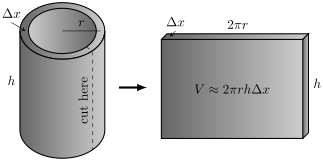
Do a similar process with a cylindrical shell, with height \(h\text{,}\) thickness \(\Delta x\text{,}\) and approximate radius \(r\text{.}\) Cutting the shell and laying it flat forms a rectangular solid with length \(2\pi r\text{,}\) height \(h\) and depth \(\dx\text{.}\) Thus the volume is \(V \approx 2\pi rh\dx\text{;}\) see Figure 7.3.3(b). (We say “approximately” since our radius was an approximation.)
The left side of the image contains a cylinder, and the right side of the image shows a rectangle which comes from unraveling the side of the cylinder. The cylinder has a height \(h \text{,}\) radius \(r \) and is pictured lying on its circular base. Both the circular base, and the top of the cylinder are shaded, while the curved surface is unshaded, but contains a “cut here” instruction. Once the curved surface of the cylinder is cut, it is unraveled into a rectangular region as seen on the right side of the image. This rectangular region has a height \(h \) and a base \(2\pi r \text{.}\) The area of the rectangle is \(A=2\pi r h \text{.}\)
The left side of the image contains a cylindrical shell, which is just a cylinder with the middle part cut out. The right side of the image shows a rectangular box which comes from unraveling the cylindrical shell. The cylindrical shell has a height \(h \text{,}\) radius \(r \) which spans from the cut out center to the edge of the shell, and the shell has thickness \(\dx \) and is pictured lying on its circular base. The entire cylindrical shell is shaded, and contains a “cut here” instruction along the curved surface as in the previous image. Once the curved surface of the cylinderical shell is cut, the entire shell is unraveled into a rectangular box as seen on the right side of the image. This rectangular box has a height \(h \) and a base length of \(2\pi r \) and a thickness of \(\dx \text{.}\) The volume of the unraveled cylindrical shell is approximated the volume of the box given by \(V=2\pi r h \dx \text{.}\)
Let a solid be formed by revolving a region \(R\text{,}\) bounded by \(x=a\) and \(x=b\text{,}\) around a vertical axis. Let \(r(x)\) represent the distance from the axis of rotation to \(x\) (i.e., the radius of a sample shell) and let \(h(x)\) represent the height of the solid at \(x\) (i.e., the height of the shell). The volume of the solid is
\begin{equation*}
V = 2\pi\int_a^b r(x)h(x)\, dx\text{.}
\end{equation*}
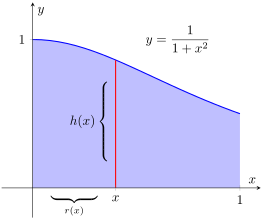
This is the region used to introduce the Shell Method in Figure 7.3.2, but is sketched again in Figure 7.3.6 for closer reference. A line is drawn in the region parallel to the axis of rotation representing a shell that will be carved out as the region is rotated about the \(y\)-axis. (This is the differential element.)
Graph of the region bounded by \(y=0\text{,}\)\(y=1/(1+x^2)\text{,}\)\(x=0\) and \(x=1\text{.}\) The curve \(y=1/(1+x^2)\) begins at the \(y\)-axis at point \((0,1) \) and slopes downwards before ending at the point \((1,\frac12) \text{.}\) The region contains the entire area below the curve, lying above the horizontal line \(y=0 \text{.}\) On the \(x\)-axis, the graph contains an arbitrarily chosen point \(x \text{.}\) The distance between the origin and the point \(x \) is given as the function \(r(x) \text{,}\) which will give us the radius of the cylindrical shell once the region is rotated about the \(y\)-axis. Additionally, coming up from the point \(x \) is a red vertical line, which ends after meeting the curve \(y=1/(1+x^2)\text{.}\) This vertical line is labeled \(h(x)\text{,}\) and will give the us the height of the cylindrical shell.
The distance this line is from the axis of rotation determines \(r(x)\text{;}\) as the distance from \(x\) to the \(y\)-axis is \(x\text{,}\) we have \(r(x)=x\text{.}\) The height of this line determines \(h(x)\text{;}\) the top of the line is at \(y=1/(1+x^2)\text{,}\) whereas the bottom of the line is at \(y=0\text{.}\) Thus \(h(x) = 1/(1+x^2)-0 = 1/(1+x^2)\text{.}\) The region is bounded from \(x=0\) to \(x=1\text{,}\) so the volume is
\begin{align*}
V \amp = 2\pi\int_0^1 \frac{x}{1+x^2}\, dx.
\end{align*}
This requires substitution. Let \(u=1+x^2\text{,}\) so \(du = 2x\, dx\text{.}\) We also change the bounds: \(u(0) = 1\) and \(u(1) = 2\text{.}\) Thus we have:
Example7.3.7.Finding volume using the Shell Method.
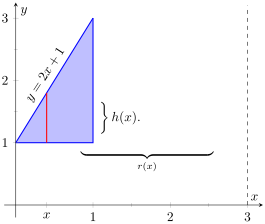
Find the volume of the solid formed by rotating the triangular region determined by the points \((0,1)\text{,}\)\((1,1)\) and \((1,3)\) about the line \(x=3\text{.}\)
The region is sketched in Figure 7.3.8(a) along with the differential element, a line within the region parallel to the axis of rotation. In Figure 7.3.8(b), we see the shell traced out by the differential element, and in Figure 7.3.8(c) the whole solid is shown.
Graph of the triangular region with edges on the points \((0,1)\text{,}\)\((1,1) \) and \((1,3)\text{.}\) The leftmost point of the triangular region begins at the \(y\)-axis at point \((0,1) \) and linearly increases until the point \((1,3) \text{.}\) The equation of the line between the points \((0,1) \) and \((1,3) \) is given to be \(y=2x+1 \text{.}\) The region contains the entire area below the curve, lying above the horizontal line \(y=1 \text{.}\) Above the \(x\)-axis, the graph showcases the distance between an arbitrarily chosen value on the \(x\)-axis, labeled \(x \text{,}\) which is between \(0 \) and \(1\text{,}\) and the axis of rotation at \(x=3 \text{.}\) The distance between these two \(x \) values is given as the function \(r(x) \text{,}\) which will give us the radius of the cylindrical shell once the region is rotated about the vertical line \(x=3\text{.}\) Additionally, coming up from the point \((x,1) \) is a red vertical line, which meets the upper bound of the triangular region, which is given by the line \(y=2x+1 \text{.}\) This vertical line is labeled \(h(x)\text{,}\) and will give the us the height of the cylindrical shell.
A three dimensional graph of the same triangular region with edges on the points \((0,1)\text{,}\)\((1,1) \) and \((1,3)\) and an arbitrary cylindrical shell which lies inside the triangular region rotated about \(x=3\text{.}\) The cylindrical shell is centered at the line \(x=3 \) and radius \(r(x) \text{,}\) which spans from arbitrarily chosen value on the \(x\)-axis between \(x=0 \) and \(x=1\text{,}\) and the axis of rotation at \(x=3 \text{.}\) The height of the cylindrical shell is \(h(x) \text{,}\) which is the distance between the point \((x,1) \) and upper bound of the triangular region at the particular value of \(x\text{.}\)
A three dimensional plot showing the same triangular region rotated about \(x=3\text{.}\) The resulting shape lies entirely above \(x=1 \text{.}\) The leftmost point of the shape is the point \((0,1) \text{,}\) which is the leftmost point of the original triangle. The shape is then rotated in a full circle around the vertical line \(x=3 \text{.}\) The resulting shape has a base of radius of \(3 \text{,}\) whose center is an empty central cylinder of radius \(2 \) centered at the axis of rotation. As we move up the shape, the thickness tapers off as the line \(y=2x+1\) reaches the point \((3,1)\) in the original triangular region. The point \((3,1)\) rotated about the line \(x=3 \) then becomes the top of the resulting shape, while the base of the triangle, which is between the points \((0,1) \) and \((1,1) \) becomes the base.
The height of the differential element is the distance from \(y=1\) to \(y=2x+1\text{,}\) the line that connects the points \((0,1)\) and \((1,3)\text{.}\) Thus \(h(x) = 2x+1-1 = 2x\text{.}\) The radius of the shell formed by the differential element is the distance from \(x\) to \(x=3\text{;}\) that is, it is \(r(x)=3-x\text{.}\) The \(x\)-bounds of the region are \(x=0\) to \(x=1\text{,}\) giving
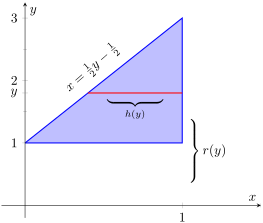
The region is sketched in Figure 7.3.10(a) with a sample differential element. In Figure 7.3.10(b) the shell formed by the differential element is drawn, and the solid is sketched in Figure 7.3.10(c). (Note that the triangular region looks “short and wide” here, whereas in the previous example the same region looked “tall and narrow.” This is because the bounds on the graphs are different.)
The height of the differential element is an \(x\)-distance, between \(x=\frac12y-\frac12\) and \(x=1\text{.}\) Thus \(h(y) = 1-(\frac12y-\frac12) = -\frac12y+\frac32\text{.}\) The radius is the distance from \(y\) to the \(x\)-axis, so \(r(y) =y\text{.}\) The \(y\) bounds of the region are \(y=1\) and \(y=3\text{,}\) leading to the integral
Graph of the triangular region with edges on the points \((0,1)\text{,}\)\((1,1) \) and \((1,3)\text{.}\) The leftmost point of the triangular region begins at the \(y\)-axis at point \((0,1) \) and linearly increases until the point \((1,3) \text{.}\) The equation of the line between the points \((0,1) \) and \((1,3) \) is given as \(x=\frac12y-\frac12 \text{.}\) The region contains the entire area to the right of the line \(x=\frac12y-\frac12 \) and to the left of the vertical line \(x=1 \text{.}\) Coming up from the \(x\)-axis, the graph contains an arbitrarily chosen value on the \(y\)-axis, labeled \(y \text{,}\) which is between \(1 \) and \(3\text{.}\) The graph showcases the distance between the point labeled \(y\) and the axis of rotation which is \(y=0 \text{.}\) The distance between these two \(y \) values is given as the function \(r(y) \text{,}\) which will give us the radius of the cylindrical shell once the solid is formed by rotating about the \(x\)-axis. Additionally, coming up from the line \(x=\frac12y-\frac12 \) is a red horizontal line, which meets the right side of the triangular region, which is given by the vertical line \(x=1 \text{.}\) This vertical line is labeled \(h(y)\text{,}\) and will give the us the height of the cylindrical shells.
A three dimensional graph of the same triangular region as the previous image and an arbitrary cylindrical shell which lies inside the triangular region rotated about the \(x\)-axis. The cylindrical shell lies horizontally resting on its curved surface, and is centered at the line \(y=0 \text{.}\) The cylindrical shell has radius \(r(y) \text{,}\) which spans from the \(y\)-axis to the arbitrarily chosen value on the \(y\)-axis between \(y=1 \) and \(y=3\text{.}\) The height of the cylindrical shell is \(h(y) \text{,}\) which is the distance between the line \(x=\frac12y-\frac12 \) and the rightmost bound of the triangular region, which is the vertical line \(x=1\text{.}\)
A three dimensional plot showing the same triangular region rotated about the \(x\)-axis. The resulting shape lies entirely between \(x=0 \) and \(x=1 \text{.}\) The highest point of the shape is the point \((1,3) \text{,}\) which is the highest point of the original triangle. The shape is then rotated in a full circle about the \(x\)-axis. The resulting shape has a height given by the value \(h(y)= -\frac12y+\frac32 \text{.}\) The radius of the shape is given by \(r(y)=y\text{,}\) with the \(y\) bounds between \(y=1\) and \(y=3\) as the center of the shape is an empty central cylinder of radius \(1 \) centered at the axis of rotation.
At the beginning of this section it was stated that “it is good to have options.” The next example finds the volume of a solid rather easily with the Shell Method, but using the Washer Method would be quite a chore.
Example7.3.11.Finding volume using the Shell Method.
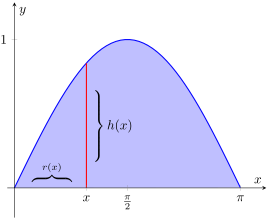
Find the volume of the solid formed by revolving the region bounded by \(y= \sin(x)\) and the \(x\)-axis from \(x=0\) to \(x=\pi\) about the \(y\)-axis.
Graph of the region bounded by \(y= \sin(x)\) and the \(x\)-axis from \(x=0\) to \(x=\pi\text{.}\) The leftmost point of the triangular region begins at the origin after which we see a singular sine wave ending at the point \((\pi,0) \text{.}\) The region contains the entire area to below the curve \(y= \sin(x)\text{,}\) lying above the \(x\)-axis. The graph contains an arbitrarily chosen value on the \(x\)-axis, labeled \(x \text{,}\) which is between \(0 \) and \(\pi\text{.}\) The graph showcases the distance between the axis of rotation which is \(x=0 \) and the point labeled \(x\) as the function \(r(x) \text{,}\) which will be the radius of the cylindrical shells. Additionally, coming up from the \(x\)-axis is a red vertical line, which meets the curve \(y= \sin(x)\) at the point \((x,\sin(x))\text{.}\) This vertical line is labeled \(h(x)\text{,}\) and will give the us the height of the cylindrical shells.
A three dimensional graph of the same region as the previous image and an arbitrary cylindrical shell which will lie inside the region rotated about the \(x\)-axis. The cylindrical shell lies vertically resting on its flat base and is centered on the \(y\)-axis. The cylindrical shell has radius \(r(x)=x \text{,}\) which spans from the \(y\)-axis to the arbitrarily chosen value on the \(x\)-axis between \(x=0 \) and \(x=\pi\text{.}\) The height of the cylindrical shell is \(h(x)=\sin(x) \text{,}\) which is the distance between the \(x\)-axis and the upper bound of the region, which curve \(y=\sin(x)\text{.}\)
A three dimensional plot showing the entire region rotated about the \(y\)-axis. The base of the shape is a circle of radius \(\pi\) centered at the origin. From the outside edge of the circle, the surface curves both upwards and inwards towards the positive \(y\)-axis until reaching a peak at \(y=1\text{.}\) From here, the surface curves downwards and inwards until closing in at the origin. The cylinderical shells lying inside the shape have a height given by \(h(x)= \sin(x) \) and radius \(r(x)=x\text{.}\)
The radius of a sample shell is \(r(x) = x\text{;}\) the height of a sample shell is \(h(x) = \sin(x)\text{,}\) each from \(x=0\) to \(x=\pi\text{.}\) Thus the volume of the solid is
\begin{align*}
V \amp = 2\pi\int_0^{\pi} x\sin(x) \, dx.
\end{align*}
This requires Integration By Parts. Set \(u=x\) and \(dv=\sin(x) \, dx\text{;}\) we leave it to the reader to fill in the rest. We have:
Note that in order to use the Washer Method, we would need to solve \(y=\sin(x)\) for \(x\text{,}\) requiring the use of the arcsine function. We leave it to the reader to verify that the outside radius function is \(R(y) = \pi-\arcsin y\) and the inside radius function is \(r(y)=\arcsin y\text{.}\) Thus the volume can be computed as
As in the previous section, the real goal of this section is not to be able to compute volumes of certain solids. Rather, it is to be able to solve a problem by first approximating, then using limits to refine the approximation to give the exact value. In this section, we approximate the volume of a solid by cutting it into thin cylindrical shells. By summing up the volumes of each shell, we get an approximation of the volume. By taking a limit as the number of equally spaced shells goes to infinity, our summation can be evaluated as a definite integral, giving the exact value.
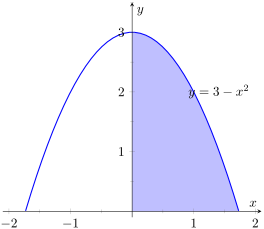
Graph of the region bounded by the curve \(y=3-x^2\text{,}\) the \(x\)-axis, and the \(y\)-axis. Note that this region can reference both the regions to the left or right of the \(y\)-axis, but we will consider the region to the right of the \(y\)-axis. The curve \(y=3-x^2\) begins at the point \((0,3)\) from which it slopes down until reaching the \(x\)-axis. The region then contains the entire area below this curve, and above the \(x\)-axis.
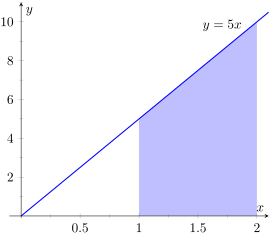
Graph of the region between \(y=5x\) and the \(x\)-axis, for \(1\leq x\leq 2\text{.}\) The line \(y=5x\) begins at the point \((1,5)\) from which it linearly increases until reaching the rightmost bound which is at the point \((2,10)\text{.}\) The region then contains the entire area below the line \(y=5x\) and above the \(x\)-axis for \(1\leq x\leq 2\text{.}\)
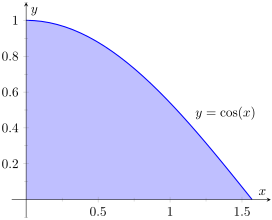
Graph of the region between \(y=\cos(x)\) and the \(x\)-axis, for \(0\leq x\leq \pi/2\text{.}\) The curve \(y=\cos(x)\) begins at the point \((0,1)\) from which it slopes downwards until ending after reaching the \(x\)-axis at the point \((\pi/2,0)\text{.}\) The region then contains the entire area below the curve \(y=\cos(x)\) and above the \(x\)-axis for \(0\leq x\leq \pi/2\text{.}\) The bound \(0\leq x\leq \pi/2\) can also be interpreted as the leftmost bound of the region being the \(y\)-axis.
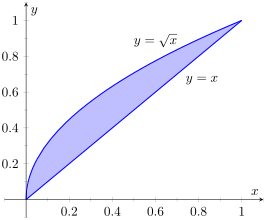
Graph of the region between the curves \(y=x\) and \(y=\sqrt{x}\text{.}\) The curves \(y=x\) and \(y=\sqrt{x}\) both begin at the origin. From this point the curve \(y=\sqrt{x}\) rises above the line \(y=x\) until reaching the point \((1,1)\text{,}\) where the curve once again intersects the line. The region then contains the area below the curve \(y=\sqrt{x}\) and above the line \(y=x\text{.}\)
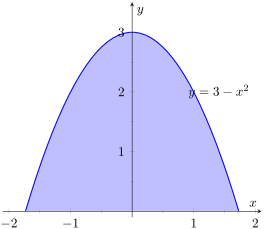
Graph of the region between \(y=3-x^2\) and the \(x\)-axis. The curve \(y=3-x^2\) begins at \(x\)-axis at the point \((-\sqrt{3},0)\text{.}\) From this point the curve rises until reaching the \(y\)-axis at the point \((0,3)\text{.}\) From this point, the curve slopes downwards until once again reaching the \(x\)-axis at the point \((\sqrt{3},0)\text{.}\) On both the left and right sides of the region, the area is bounded by the curve \(y=3-x^2\text{.}\)
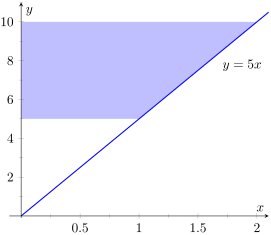
Graph of the region between \(y=5x\) and the \(y\) axis, for \(5\leq y\leq 10\text{.}\) The line \(y=5x\) begins at the point \((1,5)\text{,}\) from which it linearly increases until ending upper bound for \(y\) at the point \((2,10)\text{.}\) The region then contains the entire area to the right of \(x=0\) and to the left of the line \(y=5x\) for \(y\) between \(5\) and \(10\text{.}\)
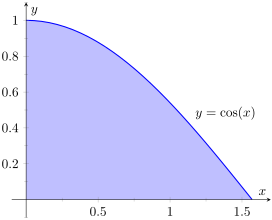
Graph of the region between \(y=\cos(x)\) and the \(x\) axis, for \(0\leq x\leq \pi/2\text{.}\) The curve \(y=\cos(x)\) begins at the point \((0,1)\) from which it slopes downwards until ending after reaching the \(x\)-axis at the point \((\pi/2,0)\text{.}\) The region then contains the entire area to the right of \(x=0\) and to the left of of the curve \(y=\cos(x)\) for \(y\) values between \(0\) and \(1\text{.}\)
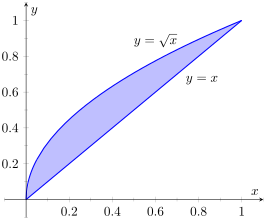
Graph of the region between the curves \(y=x\) and \(y=\sqrt{x}\text{.}\) The curves \(y=x\) and \(y=\sqrt{x}\) both begin at the origin. From this point the curve \(y=\sqrt{x}\) rises above the line \(y=x\) until reaching the point \((1,1)\text{,}\) where the curve once again intersects the line. The region consists of the area to the right of the curve \(y=\sqrt{x}\) and the to the left line \(y=x\) for \(y\) values between \(0\) and \(1\text{.}\)