The definite integral of \(f\) over \([a,b]\text{,}\)\(\int_a^b f(x)\, dx\text{,}\) was introduced as “the signed area under the curve.” We approximated the value of this area by first subdividing \([a,b]\) into \(n\) subintervals, where the \(i\)th subinterval has length \(\dx_i\text{,}\) and letting \(c_i\) be any value in the \(i\)th subinterval. We formed rectangles that approximated part of the region under the curve with width \(\dx_i\text{,}\) height \(f(c_i)\text{,}\) and hence with area \(f(c_i)\dx_i\text{.}\) Summing all the rectangle’s areas gave an approximation of the definite integral, and Theorem 5.3.26 stated that
Let \(R\) be a closed, bounded region in the \(xy\)-plane and let \(z=f(x,y)\) be a continuous function defined on \(R\text{.}\) We wish to find the signed volume under the graph of \(f\) over \(R\text{.}\) (We use the term “signed volume” to denote that space above the \(xy\)-plane, under \(f\text{,}\) will have a positive volume; space above \(f\) and under the \(xy\)-plane will have a “negative” volume, similar to the notion of signed area used before.)
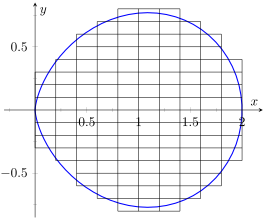
We start by partitioning \(R\) into \(n\) rectangular subregions as shown in Figure 14.2.2(a). For simplicity’s sake, we let all widths be \(\dx\) and all heights be \(\dy\text{.}\) Note that the sum of the areas of the rectangles is not equal to the area of \(R\text{,}\) but rather is a close approximation. Arbitrarily number the rectangles 1 through \(n\text{,}\) and pick a point \((x_i,y_i)\) in the \(i\)th subregion.
A surface is plotted in space, against three-dimensional coordinate axes. In the \(xy\) plane, there is a copy of the region from Figure 14.2.2(a), including a rendering of the rectangular grid representing the partition of the region into small rectangles.
The surface lies above the \(xy\) plane. On the surface, we can see a curve that corresponds to the boundary of the region in the \(xy\) plane. The grid lines on the surface also appear to correspond to the partition of the region below the surface.
Over one of the small rectangles in the \(xy\) plane, there is a rectangular box. The base of the box is the rectangle in the plane. The box extends upward to the surface, with its height equal to the \(z\) coordinate on the surface at one point in the rectangle.
The volume of the rectangular solid whose base is the \(i\)th subregion and whose height is \(f(x_i,y_i)\) is \(V_i=f(x_i,y_i)\dx\dy\text{.}\) Such a solid is shown in Figure 14.2.2(b). Note how this rectangular solid only approximates the true volume under the surface; part of the solid is above the surface and part is below.
For each subregion \(R_i\) used to approximate \(R\text{,}\) create the rectangular solid with base area \(\dx\dy\) and height \(f(x_i,y_i)\text{.}\) The sum of all rectangular solids is
This approximates the signed volume under \(f\) over \(R\text{.}\) As we have done before, to get a better approximation we can use more rectangles to approximate the region \(R\text{.}\)
In general, each rectangle could have a different width \(\dx_j\) and height \(\dy_k\text{,}\) giving the \(i\)th rectangle an area \(\Delta A_i = \dx_j\dy_k\) and the \(i\)th rectangular solid a volume of \(f(x_i,y_i)\Delta A_i\text{.}\) Let \(\norm{\Delta A}\) denote the length of the longest diagonal of all rectangles in the subdivision of \(R\text{;}\)\(\norm{\Delta A}\to 0\) means each rectangle’s width and height are both approaching 0. If \(f\) is a continuous function, as \(\norm{\Delta A}\) shrinks (and hence \(n\to\infty\)) the summation \(\ds \sum_{i=1}^n f(x_i,y_i)\Delta A_i\) approximates the signed volume better and better. This leads to a definition.
Let \(z=f(x,y)\) be a continuous function defined over a closed, bounded region \(R\) in the \(xy\)-plane. The signed volume \(V\) under \(f\) over \(R\) is denoted by the double integral
\begin{equation*}
V = \iint_R f(x,y)\, dA\text{.}
\end{equation*}
Definition 14.2.3 does not state how to find the signed volume, though the notation offers a hint. We need the next two theorems to evaluate double integrals to find volume.
Let \(z=f(x,y)\) be a continuous function defined over a closed , bounded region \(R\) in the \(xy\)-plane. Then the signed volume \(V\) under \(f\) over \(R\) is
\begin{equation*}
V = \iint_R f(x,y)\, dA = \lim_{\norm{\Delta A}\to 0}\sum_{i=1}^n f(x_i,y_i)\Delta A_i\text{.}
\end{equation*}
This theorem states that we can find the exact signed volume using a limit of sums. The partition of the region \(R\) is not specified, so any partitioning where the diagonal of each rectangle shrinks to 0 results in the same answer.
This does not offer a very satisfying way of computing volume, though. Our experience has shown that evaluating the limits of sums can be tedious. We seek a more direct method.
Recall Theorem 7.2.3 in Section 7.2. This stated that if \(A(x)\) gives the cross-sectional area of a solid at \(x\text{,}\) then \(\int_a^b A(x)\, dx\) gave the volume of that solid over \([a,b]\text{.}\)
Consider Figure 14.2.6, where a surface \(z=f(x,y)\) is drawn over a region \(R\text{.}\) Fixing a particular \(x\) value, we can consider the area under \(f\) over \(R\) where \(x\) has that fixed value. That area can be found with a definite integral, namely
The plot begins with a set of three-dimensional coordinate axes. In the \(xy\) plane, there is a curve that appears to be a circle of radius 1, centered at \((1,0,0)\text{.}\)
The circle is the boundary of a region \(R\text{.}\) Above this region, there is a surface; the surface has the shape of a downward-opening circular paraboloid.
A portion of a vertical plane is also drawn. The plane corresponds to a fixed value of \(x\text{,}\) and extends in the \(y\) direction across the circle. The plane is shown extending upward to the surface, which it intersects along a curve. We can think of this portion of the plane as a “slice” of the solid that lies below the paraboloid and above the circle.
Remember that though the integrand contains \(x\text{,}\) we are viewing \(x\) as fixed. Also note that the bounds of integration are functions of \(x\text{:}\) the bounds depend on the value of \(x\text{.}\)
This gives a concrete method for finding signed volume under a surface. We could do a similar procedure where we started with \(y\) fixed, resulting in an iterated integral with the order of integration \(dx\, dy\text{.}\) The following theorem states that both methods give the same result, which is the value of the double integral. It is such an important theorem it has a name associated with it.
If \(R\) is bounded by \(a\leq x\leq b\) and \(g_1(x)\leq y\leq g_2(x)\text{,}\) where \(g_1\) and \(g_2\) are continuous functions on \([a,b]\text{,}\) then
\begin{equation*}
\iint_R f(x,y)\, dA = \int_a^b\int_{g_1(x)}^{g_2(x)} f(x,y)\, dy\, dx\text{.}
\end{equation*}
If \(R\) is bounded by \(c\leq y\leq d\) and \(h_1(y)\leq x\leq h_2(y)\text{,}\) where \(h_1\) and \(h_2\) are continuous functions on \([c,d]\text{,}\) then
\begin{equation*}
\iint_R f(x,y)\, dA = \int_c^d\int_{h_1(y)}^{h_2(y)} f(x,y)\, dx\, dy\text{.}
\end{equation*}
Note that once again the bounds of integration follow the “curve to curve, point to point” pattern discussed in the previous section. In fact, one of the main points of the previous section is developing the skill of describing a region \(R\) with the bounds of an iterated integral. Once this skill is developed, we can use double integrals to compute many quantities, not just signed volume under a surface.
Let \(f(x,y) = xy+e^y\text{.}\) Find the signed volume under \(f\) on the region \(R\text{,}\) which is the rectangle with corners \((3,1)\) and \((4,2)\) pictured in Figure 14.2.10, using Fubini’s Theorem and both orders of integration.
The surface given by the graph of \(f(x,y)=xy+e^y\) has the appearance of a curved, twisted, and very steep ramp. Along the \(x\) axis we have the constant value \(z=1\text{.}\) For small, fixed values of \(x\text{,}\) the traces are exponential curves that increase with \(y\text{.}\) For larger values of \(x\text{,}\) the \(xy\) term contributes, and the rate of growth is larger.
In the \(xy\) plane, a rectangular region \(R\) is shown. Dashed lines move upward from the boundary of this region to the surface. Along the surface, a corresponding rectangle-shaped curve is shown. The two rectangular curves, and the dashed lines between corresponding corners, illustrate the region whose volume is computed in this example.
We wish to evaluate \(\iint_R \big(xy+e^y\big)\, dA\text{.}\) As \(R\) is a rectangle, the bounds are easily described as \(3\leq x\leq 4\) and \(1\leq y\leq 2\text{.}\)
Evaluate \(\iint_R \big(3xy-x^2-y^2+6\big)\, dA\text{,}\) where \(R\) is the triangle bounded by \(x=0\text{,}\)\(y=0\) and \(x/2+y=1\text{,}\) as shown in Figure 14.2.12.
The graph \(z = 3xy-x^2-y^2+6\) is plotted in the first octant of a three-dimensional coordinate system. It appears to be a hyperbolic paraboloid, with slight upward curvature when viewed along the plane \(y=1-x\text{,}\) and a larger downward curvature when viewed along the plane \(y=x\text{.}\)
In the \(xy\) plane, a triangular region is plotted. This region is bounded by the \(x\) and \(y\) axes, and a line segment running from \((2,0,0)\) to \((0,1,0)\text{.}\) There are also dashed, vertical lines running from these two points up to the surface.
On the surface, there are curves corresponding to the three edges of the triangle in the \(xy\) plane. These curves illustrate the portion of the surface under which the solid whose volume we are finding lies. Each curve has the shape of a downward-opening parabola.
While it is not specified which order we are to use, we will evaluate the double integral using both orders to help drive home the point that it does not matter which order we use.
Using the order \(dy\, dx\text{:}\) The bounds on \(y\) go from “curve to curve,” i.e., \(0\leq y\leq 1-x/2\text{,}\) and the bounds on \(x\) go from “point to point,” i.e., \(0\leq x\leq 2\text{.}\)
Now lets consider the order \(dx \, dy\text{.}\) Here \(x\) goes from “curve to curve,” \(0\leq x\leq 2-2y\text{,}\) and \(y\) goes from “point to point,” \(0\leq y\leq 1\text{:}\)
Note how in these examples that the bounds of integration depend only on \(R\text{;}\) the bounds of integration have nothing to do with \(f(x,y)\text{.}\) This is an important concept, so we include it as a Key Idea.
When evaluating \(\iint_R f(x,y)\, dA\) using an iterated integral, the bounds of integration depend only on \(R\text{.}\) The function \(f\) does not determine the bounds of integration.
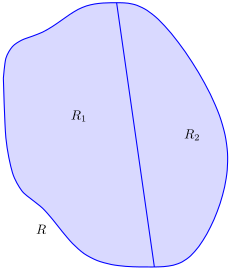
Before doing another example, we give some properties of double integrals. Each should make sense if we view them in the context of finding signed volume under a surface, over a region.
The sketch shows a generic region \(R\) in the plane. The precise shape of the region is unimportant, but its shape is like that of a pond with a rounded but uneven boundary.
Let \(f(x,y) = \sin(x) \cos(y)\) and \(R\) be the triangle with vertices \((-1,0)\text{,}\)\((1,0)\) and \((0,1)\) (see Figure 14.2.19). Evaluate the double integral \(\iint_Rf(x,y)\, dA\text{.}\)
The graph \(z=\sin(x)\cos(y)\) is plotted against a set of three-dimensional coordinate axes. It is a wave-like surface, but no crests or troughs are visible, as we only see the portion of the surface with \(-1\leq x\leq 1\) and \(0\leq y\leq 1\text{.}\)
In the \(xy\) plane, the domain of \(f(x,y)\) for this integral is shown as a triangle, with vertices at \((-1,0,0)\text{,}\)\((1,0,0)\text{,}\) and \((0,1,0)\text{.}\) In the default view of the image, this triangle is only partially visible below the surface.
If we attempt to integrate using an iterated integral with the order \(dy\, dx\text{,}\) note how there are two upper bounds on \(R\) meaning we’ll need to use two iterated integrals. We would need to split the triangle into two regions along the \(y\)-axis, then use Theorem 14.2.15, Part 5.
Instead, let’s use the order \(dx\, dy\text{.}\) The curves bounding \(x\) are \(y-1\leq x\leq 1-y\text{;}\) the bounds on \(y\) are \(0\leq y\leq 1\text{.}\) This gives us:
Recall that the cosine function is an even function; that is, \(\cos(x) = \cos(-x)\text{.}\) Therefore, from the last integral above, we have \(\cos(y-1) = \cos(1-y)\text{.}\) Thus the integrand simplifies to 0, and we have
It turns out that over \(R\text{,}\) there is just as much volume above the \(xy\)-plane as below (look again at Figure 14.2.19), giving a final signed volume of 0.
Evaluate \(\iint_R (4-y)\, dA\text{,}\) where \(R\) is the region bounded by the parabolas \(y^2=4x\) and \(x^2=4y\text{,}\) graphed in Figure 14.2.22.
The graph \(z=4-y\) is a plane. It is plotted as a rectangular region in the first octant, intersecting the \(xy\) plane along the line \(y=4\text{,}\) and the \(xz\) plane along the line \(z=4\text{.}\)
The parabolas \(y^2=4x\) and \(x^2=4y\) are sketched in the \(xy\) plane, from the origin to their intersection at \((4,4,0)\text{.}\) On the plane, we see the corresponding curves, which are also parabolas. The region between them has the shape of a narrow leaf or petal.
Graphing each curve can help us find their points of intersection. Solving analytically, the second equation tells us that \(y=x^2/4\text{.}\) Substituting this value in for \(y\) in the first equation gives us \(x^4/16 = 4x\text{.}\) Solving for \(x\text{:}\)
Thus we’ve found analytically what was easy to approximate graphically: the regions intersect at \((0,0)\) and \((4,4)\text{,}\) as shown in Figure 14.2.22.
We now choose an order of integration: \(dy\, dx\) or \(dx\, dy\text{?}\) Either order works; since the integrand does not contain \(x\text{,}\) choosing \(dx\, dy\) might be simpler — at least, the first integral is very simple.
In the previous section we practiced changing the order of integration of a given iterated integral, where the region \(R\) was not explicitly given. Changing the bounds of an integral is more than just an test of understanding. Rather, there are cases where integrating in one order is really hard, if not impossible, whereas integrating with the other order is feasible.
Rewrite the iterated integral \(\ds \int_0^3\int_y^3 e^{-x^2}\, dx\, dy\) with the order \(dy\, dx\text{.}\) Comment on the feasibility to evaluate each integral.
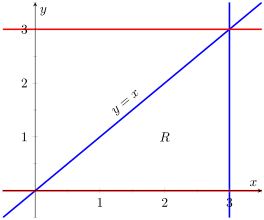
Once again we make a sketch of the region over which we are integrating to facilitate changing the order. The bounds on \(x\) are from \(x=y\) to \(x=3\text{;}\) the bounds on \(y\) are from \(y=0\) to \(y=3\text{.}\) These curves are sketched in Figure 14.2.25, enclosing the region \(R\text{.}\)
Four lines are plotted: the horizontal lines \(y=0\) (along the \(x\) axis) and \(y=3\text{,}\) the vertical line \(x=3\text{,}\) and the diagonal line \(y=x\text{.}\) The line \(y=x\) divides the square \(0\leq x,y\leq 3\) into two triangles, one below the line, and one above.
The line \(y=3\) illustrates that the upper bound for \(y\) is \(3\text{,}\) but this line is otherwise not really needed. The remaining lines \(y=0\text{,}\)\(x=3\text{,}\) and \(y=x\) form a triangle with vertices at \((0,0)\text{,}\)\((3,0)\text{,}\) and \((3,3)\text{.}\)
To change the bounds, note that the curves bounding \(y\) are \(y=0\) up to \(y=x\text{;}\) the triangle is enclosed between \(x=0\) and \(x=3\text{.}\) Thus the new bounds of integration are \(0\leq y\leq x\) and \(0\leq x\leq 3\text{,}\) giving the iterated integral \(\ds \int_0^3\int_0^x e^{-x^2}\, dy\, dx\text{.}\)
How easy is it to evaluate each iterated integral? Consider the order of integrating \(dx\, dy\text{,}\) as given in the original problem. The first indefinite integral we need to evaluate is \(\int e^{-x^2}\, dx\text{;}\) we have stated before (see Section 5.5) that this integral cannot be evaluated in terms of elementary functions. We are stuck.
Changing the order of integration makes a big difference here. In the second iterated integral, we are faced with \(\int e^{-x^2}\, dy\text{;}\) integrating with respect to \(y\) gives us \(ye^{-x^2}+C\text{,}\) and the first definite integral evaluates to
\begin{equation*}
\int_0^x e^{-x^2}\, dy = xe^{-x^2}\text{.}
\end{equation*}
This last integral is easy to evaluate with substitution, giving a final answer of \(\frac12(1-e^{-9})\approx 0.5\text{.}\)Figure 14.2.26 shows the surface over \(R\text{.}\)
In two dimensions, the graph \(y=e^{-x^2}\) is a bell curve, with a peak at \((0,1)\text{.}\) The surface \(z=e^{-x^2}\) is a cylinder through this curve. We are shown a portion of this surface with \(x\geq 0\text{,}\) which has the appearance of a wave parallel to the \(y\) axis that reaches its crest when \(x=0\text{.}\)
The triangular domain is sketched in the \(xy\) plane, with vertices at \((0,0,0)\text{,}\)\((3,0,0)\text{,}\) and \((3,3,0)\text{,}\) but it is mostly obscured by the surface.
Definition 5.4.34 defines the average value of a single-variable function \(f(x)\) on the interval \([a,b]\) as
\begin{equation*}
\text{ average value of \(f(x)\) on \([a,b]\) } = \frac1{b-a}\int_a^b f(x)\, dx;
\end{equation*}
that is, it is the “area under \(f\) over an interval divided by the length of the interval.” We make an analogous statement here: the average value of \(z=f(x,y)\) over a region \(R\) is the volume under \(f\) over \(R\) divided by the area of \(R\text{.}\)
Example14.2.29.Finding average value of a function over a region \(R\).
Find the average value of \(f(x,y) = 4-y\) over the region \(R\text{,}\) which is bounded by the parabolas \(y^2=4x\) and \(x^2=4y\text{.}\) Note: this is the same function and region as used in Example 14.2.21.
The graph \(z=4-y\) is a plane. It is plotted as a rectangular region in the first octant, intersecting the \(xy\) plane along the line \(y=4\text{,}\) and the \(xz\) plane along the line \(z=4\text{.}\)
The parabolas \(y^2=4x\) and \(x^2=4y\) are sketched in the \(xy\) plane, from the origin to their intersection at \((4,4,0)\text{.}\) On the plane, we see the corresponding curves, which are also parabolas. The region between them has the shape of a narrow leaf or petal.
The previous section introduced the iterated integral in the context of finding the area of plane regions. This section has extended our understanding of iterated integrals; now we see they can be used to find the signed volume under a surface.
This new understanding allows us to revisit what we did in the previous section. Given a region \(R\) in the plane, we computed \(\iint_R 1\, dA\text{;}\) again, our understanding at the time was that we were finding the area of \(R\text{.}\) However, we can now view the graph \(z=1\) as a surface, a flat surface with constant \(z\)-value of 1. The double integral \(\iint_R 1\, dA\) finds the volume, under \(z=1\text{,}\) over \(R\text{,}\) as shown in Figure 14.2.31. Basic geometry tells us that if the base of a general right cylinder has area \(A\text{,}\) its volume is \(A\cdot h\text{,}\) where \(h\) is the height. In our case, the height is 1. We were “actually” computing the volume of a solid, though we interpreted the number as an area.
A circular cylinder is plotted in three dimensions. The cylinder appears to lie over a circle with center \((1,0,0)\) and radius \(1\) in the \(xy\) plane.
The image is used to illustrate that for any region in the plane, there is a cylinder that lies over the region, between the planes \(z=0\) and \(z=1\text{.}\) A double integral of the form \(\iint_R 1 \, dA\) can be thought of as either computing the area of the region \(R\text{,}\) or the volume of the corresponding cylinder of height \(1\) over \(R\text{.}\)
The next section extends our abilities to find “volumes under surfaces.” Currently, some integrals are hard to compute because either the region \(R\) we are integrating over is hard to define with rectangular curves, or the integrand itself is hard to deal with. Some of these problems can be solved by converting everything into polar coordinates.
State why it is difficult/impossible to integrate the iterated integral in the given order of integration. Change the order of integration and evaluate the new iterated integral.
Find the average value of \(f\) over the region \(R\text{.}\) Notice how these functions and regions are related to the iterated integrals given in Exercises 5–8.