Thus far we have focused mostly on 2-dimensional vector fields, measuring flow and flux along/across curves in the plane. Both Green’s Theorem and the Divergence Theorem make connections between planar regions and their boundaries. We now move our attention to 3-dimensional vector fields, considering both curves and surfaces in space.
We are accustomed to describing surfaces as functions of two variables, usually written as \(z=f(x,y)\text{.}\) For our coming needs, this method of describing surfaces will prove to be insufficient. Instead, we will parametrize our surfaces, describing them as the set of terminal points of some vector-valued function \(\vec r(u,v) =\langle f(u,v),g(u,v),h(u,v)\rangle\text{.}\) The bulk of this section is spent practicing the skill of describing a surface \(\surfaceS\)using a vector-valued function. Once this skill is developed, we’ll show how to find the surface area \(S\) of a parametrically-defined surface \(\surfaceS\text{,}\) a skill needed in the remaining sections of this chapter.
Let \(\vec r(u,v) = \langle\, f(u,v),g(u,v),h(u,v)\rangle\) be a vector-valued function that is continuous and one to one on the interior of its domain \(R\) in the \(u\)-\(v\) plane. The set of all terminal points of \(\vec r\) (i.e., the range of \(\vec r\) ) is the surface \(\surfaceS\text{,}\) and \(\vec r\) along with its domain \(R\) form a parametrization of \(\surfaceS\text{.}\)
This parametrization is smooth on \(R\) if \(\vec r_u\) and \(\vec r_v\) are continuous and \(\vec r_u\times \vec r_v\) is never \(\vec 0\) on the interior of \(R\text{.}\)
Given a point \((u_0,v_0)\) in the domain of a vector-valued function \(\vec r\text{,}\) the vectors \(\vec r_u(u_0,v_0)\) and \(\vec r_v(u_0,v_0)\) are tangent to the surface \(\surfaceS\) at \(\vec r(u_0,v_0)\) (a proof of this is developed later in this section). The definition of smoothness dictates that \(\vec r_u\times \vec r_v \neq \vec 0\text{;}\) this ensures that neither \(\vec r_u\) nor \(\vec r_v\) are \(\vec 0\text{,}\) nor are they ever parallel. Therefore smoothness guarantees that \(\vec r_u\) and \(\vec r_v\) determine a plane that is tangent to \(\surfaceS\text{.}\)
A surface \(\surfaceS\) is said to be orientable if a field of normal vectors can be defined on \(\surfaceS\) that vary continuously along \(\surfaceS\text{.}\) This definition may be hard to understand; it may help to know that orientable surfaces are often called “two sided.” A sphere is an orientable surface, and one can easily envision an “inside” and “outside” of the sphere. A paraboloid is orientable, where again one can generally envision “inside” and “outside” sides (or “top” and “bottom” sides) to this surface. Just about every surface that one can imagine is orientable, and we’ll assume all surfaces we deal with in this text are orientable.
It is enlightening to examine a classic non-orientable surface: the Möbius band, shown in Figure 15.5.3. Vectors normal to the surface are given, starting at the point indicated in the figure. These normal vectors “vary continuously” as they move along the surface. Letting each vector indicate the “top” side of the band, we can easily see near any vector which side is the “top”.
However, if as we progress along the band, we recognize that we are labeling “both sides” of the band as the top; in fact, there are not two “sides” to this band, but one. The Möbius band is a non-orientable surface.
A Möbius band is the surface one obtains by taking a strip of paper, giving it a half-twist, and gluing the ends of the strip together. It is a famous example of a surface with only one side.
This is illustrated in the image by plotting a collection of normal vectors along the “central curve” of the surface. (This is the curve obtained if you draw a line down the middle of your strip of paper before connecting the two ends.) The normal vector begins its trip pointing up, but as it travels around the curve it rotates, and ends up pointing down when we return to the starting point of the curve.
There is a straightforward way to parametrize a surface of the form \(z=f(x,y)\) over a rectangular domain. We let \(x=u\) and \(y=v\text{,}\) and let \(\vec r(u,v) = \langle u,v, f(u,v)\rangle\text{.}\) In this instance, we have \(\vec r(u,v) = \langle u,v,u^2+2v^2\rangle\text{,}\) for \(-3\leq u\leq 3\text{,}\)\(-1\leq v\leq 1\text{.}\) This surface is graphed in Figure 15.5.5.
A set of three-dimensional coordinate axes are shown, with the \(z\) axis pointing up. In the \(xy\) plane a shaded rectangle is plotted; this represents the parameter domain. Sitting above the rectangle is a portion of an elliptic paraboloid, opening upward. The appearance of the surface is similar to that of a hammock or sling.
We can parametrize the circular boundary of \(R\) with the vector-valued function \(\la 2\cos(u),2\sin(u)\ra\text{,}\) where \(0\leq u\leq 2\pi\text{.}\) We can obtain the interior of \(R\) by scaling this function by a variable amount, i.e., by multiplying by \(v\text{:}\)\(\la 2v\cos(u),2v\sin(u)\ra\text{,}\) where \(0\leq v\leq 1\text{.}\)
It is important to understand the role of \(v\) in the above function. When \(v=1\text{,}\) we get the boundary of \(R\text{,}\) a circle of radius 2. When \(v=0\text{,}\) we simply get the point \((0,0)\text{,}\) the center of \(R\) (which can be thought of as a circle with radius of 0). When \(v=1/2\text{,}\) we get the circle of radius \(1\) that is centered at the origin, which is the circle halfway between the boundary and the center. As \(v\) varies from 0 to 1, we create a series of concentric circles that fill out all of \(R\text{.}\)
A set of three-dimensional coordinate axes are shown, with the \(z\) axis pointing up. In the \(xy\) plane a shaded circle is plotted, with its center at the origin; this represents the parameter domain. Sitting above the circle is a portion of an elliptic paraboloid, opening upward. Because the domain is circular, the surface appears more bowl-shaped than in the previous example.
Thus far, we have determined the \(x\) and \(y\) components of our parametrization of the surface: \(x=2v\cos(u)\) and \(y=2v\sin(u)\text{.}\) We find the \(z\) component simply by using \(z = f(x,y) = x^2+2y^2\text{:}\)
\begin{equation*}
z = (2v\cos(u))^2+2(2v\sin(u))^2 = 4v^2\cos^2u+8v^2\sin^2u\text{.}
\end{equation*}
Thus \(\vec r(u,v) = \langle 2v\cos(u),2v\sin(u),4v^2\cos^2u+8v^2\sin^2u\rangle\text{,}\)\(0\leq u\leq 2\pi\text{,}\)\(0\leq v\leq 1\text{,}\) which is graphed in Figure 15.5.7. The way that this graphic was generated highlights how the surface was parametrized. When viewing from above, one can see lines emanating from the origin; they represent different values of \(u\) as \(u\) sweeps from an angle of 0 up to \(2\pi\text{.}\) One can also see concentric circles, each corresponding to a different value of \(v\text{.}\)
Examples 15.5.4 and 15.5.6 demonstrate an important principle when parametrizing surfaces given in the form \(z=f(x,y)\) over a region \(R\text{:}\) if one can determine \(x\) and \(y\) in terms of \(u\) and \(v\text{,}\) then \(z\) follows directly as \(z=f(x,y)\text{.}\)
In the following two examples, we parametrize the same surface over triangular regions. Each will use \(v\) as a “scaling factor” as done in Example 15.5.6.
Example15.5.8.Parametrizing a surface over a triangle.
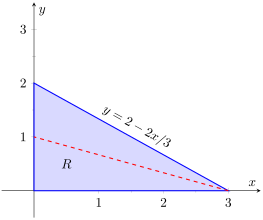
Parametrize the surface \(z=x^2+2y^2\) over the triangular region \(R\) enclosed by the coordinate axes and the line \(y=2-2x/3\text{,}\) as shown in Figure 15.5.9(a).
The first quadrant in the plane is shown, with the \(x\) axis at the bottom of the image, and the \(y\) axis to the left. A triangular region is shaded and labeled as \(R\text{.}\) It is a right triangle, with its base along the \(x\) axis, from \((0,0)\) to \((3,0)\text{,}\) and another side along the \(y\) axis, from \((0,0)\) to \((0,2)\text{.}\)
The hypotenuse, from \((0,2)\) to \((3,0)\text{,}\) is labeled with the equation \(y=2-2x/3\text{.}\) A dashed line is also drawn through the region, from \((0,1)\) to \((3,0)\text{.}\) This illustrates the parameter value \(v=\frac12\text{.}\)
A set of three-dimensional coordinate axes are drawn, with the \(z\) axis pointing up. The surface \(z=x^2+2y^2\) is plotted over the triangular domain illustrated in Figure 15.5.9(a). This is the same surface as the previous two examples, plotted again with a differently-shaped domain. The domain, as usual, is rendered in the \(xy\) plane.
The shape of the surface is hard to tell from the default perspective of the image. Rotating the image, so that the viewpoint is from above, shows that the surface has a cusp at the origin, which is one corner of the domain, and the surface rises up from there into the first octant.
The sides of the domain along the \(x\) and \(y\) axes lead to parabolic curves in the \(xz\) and \(yz\) planes. These curves rise to cusps at the other corners of the domain, and they are joined by a parabolic curve in space that corresponds to the hypotenuse of the triangle.
We may begin by letting \(x=u\text{,}\)\(0\leq u\leq 3\text{,}\) and \(y = 2-2u/3\text{.}\) This gives only the line on the “upper” side of the triangle. To get all of the region \(R\text{,}\) we can once again scale \(y\) by a variable factor, \(v\text{.}\)
Still letting \(x = u\text{,}\)\(0\leq u\leq 3\text{,}\) we let \(y = v(2-2u/3)\text{,}\)\(0\leq v\leq 1\text{.}\) When \(v=0\text{,}\) all \(y\)-values are 0, and we get the portion of the \(x\)-axis between \(x=0\) and \(x=3\text{.}\) When \(v=1\text{,}\) we get the upper side of the triangle. When \(v=1/2\text{,}\) we get the line \(y=1/2(2-2u/3) = 1-u/3\text{,}\) which is the line “halfway up” the triangle, shown in the figure with a dashed line.
Letting \(z = f(x,y) = x^2+2y^2\text{,}\) we have \(\vec r(u,v) = \langle u, v(2-2u/3),
u^2+2\big(v(2-2u/3)\big)^2\rangle\text{,}\)\(0\leq u\leq 3\text{,}\)\(0\leq v\leq 1\text{.}\) This surface is graphed in Figure 15.5.9(b). Again, when one looks from above, we can see the scaling effects of \(v\text{:}\) the series of lines that run to the point \((3,0)\) each represent a different value of \(v\text{.}\)
Another common way to parametrize the surface is to begin with \(y=u\text{,}\)\(0\leq u\leq 2\text{.}\) Solving the equation of the line \(y=2-2x/3\) for \(x\text{,}\) we have \(x = 3-3y/2\text{,}\) leading to using \(x=v(3-3u/2)\text{,}\)\(0\leq v\leq 1\text{.}\) With \(z=x^2+2y^2\text{,}\) we have \(\vec r(u,v) = \langle v(3-3u/2),u, \big(v(3-3u/2)\big)^2+2v^2\rangle\text{,}\)\(0\leq u\leq 2\text{,}\)\(0\leq v\leq 1\text{.}\)
Example15.5.10.Parametrizing a surface over a triangle.
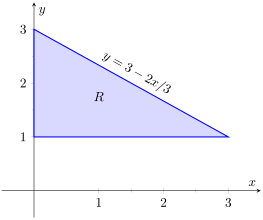
Parametrize the surface \(z=x^2+2y^2\) over the triangular region \(R\) enclosed by the lines \(y=3-2x/3\text{,}\)\(y=1\) and \(x=0\) as shown in Figure 15.5.11(a).
A set of two-dimensional coordinate axes is shown, with the origin in the bottom-left of the image. A region \(R\) is plotted as a shaded rectangle. The rectangle has vertices \((0,1)\text{,}\)\((3,1)\text{,}\) and \((0,3)\text{.}\) The hypotenuse of the triangle is labeled with the equation \(y=3-2x/3\text{.}\)
A set of three-dimensional coordinate axes are drawn, with the \(z\) axis pointing up. The surface \(z=x^2+2y^2\) is plotted over the triangular domain illustrated in Figure 15.5.11(a). This is the same surface as the previous three examples, plotted again with a different domain. The domain, as usual, is rendered in the \(xy\) plane. The image is very similar to the one in Figure 15.5.9(b), with the bottom cusp on the surface at the point \((0,1,2)\) instead of the origin.
The sides of the domain along the \(x\) and \(y\) axes lead to parabolic curves in the planes \(x=0\) and \(y=1\text{.}\) These curves rise to cusps at the other corners of the domain, and they are joined by a parabolic curve in space that corresponds to the hypotenuse of the triangle.
While the region \(R\) in this example is very similar to the region \(R\) in the previous example, and our method of parametrizing the surface is fundamentally the same, it will feel as though our answer is much different than before.
We begin with letting \(x=u\text{,}\)\(0\leq u\leq 3\text{.}\) We may be tempted to let \(y = v(3-2u/3)\text{,}\)\(0\leq v\leq 1\text{,}\) but this is incorrect. When \(v = 1\text{,}\) we obtain the upper line of the triangle as desired. However, when \(v=0\text{,}\) the \(y\)-value is 0, which does not lie in the region \(R\text{.}\)
We will describe the general method of proceeding following this example. For now, consider \(y = 1+v(2-2u/3)\text{,}\)\(0\leq v\leq 1\text{.}\) Note that when \(v=1\text{,}\) we have \(y=3-2u/3\text{,}\) the upper line of the boundary of \(R\text{.}\) Also, when \(v=0\text{,}\) we have \(y=1\text{,}\) which is the lower boundary of \(R\text{.}\) With \(z=x^2+2y^2\text{,}\) we determine \(\vec r(u,v) = \langle u, 1+v(2-2u/3),
u^2+2\big(1+v(2-2u/3)\big)^2\rangle\text{,}\)\(0\leq u\leq 3\text{,}\)\(0\leq v\leq 1\text{.}\)
Given a surface of the form \(z=f(x,y)\text{,}\) one can often determine a parametrization of the surface over a region \(R\) in a manner similar to determining bounds of integration over a region \(R\text{.}\) Using the techniques of Section 14.1, suppose a region \(R\) can be described by \(a\leq x\leq b\text{,}\)\(g_1(x) \leq y\leq g_2(x)\text{,}\) i.e., the area of \(R\) can be found using the iterated integral
When parametrizing the surface, we can let \(x=u\text{,}\)\(a\leq u\leq b\text{,}\) and we can let \(y = g_1(u)+v\big(g_2(u)-g_1(u)\big)\text{,}\)\(0\leq v\leq 1\text{.}\) The parametrization of \(x\) is straightforward, but look closely at how \(y\) is determined. When \(v=0\text{,}\)\(y=g_1(u) = g_1(x)\text{.}\) When \(v=1\text{,}\)\(y= g_2(u)=g_2(x)\text{.}\)
As a specific example, consider the triangular region \(R\) from Example 15.5.10, shown in Figure 15.5.11(a). Using the techniques of Section 14.1, we can find the area of \(R\) as
Following the above discussion, we can set \(x=u\text{,}\) where \(0\leq u\leq 3\text{,}\) and set \(y = 1+ v\big(3-2u/3-1\big) = 1+v(2-2u/3)\text{,}\)\(0\leq v\leq 1\text{,}\) as used in that example.
One can do a similar thing if \(R\) is bounded by \(c\leq y\leq d\text{,}\)\(h_1(y)\leq x\leq h_2(y)\text{,}\) but for the sake of simplicity we leave it to the reader to flesh out those details. The principles outlined above are given in the following Key Idea for reference.
Let a surface \(\surfaceS\) be the graph of a function \(f(x,y)\text{,}\) where the domain of \(f\) is a closed, bounded region \(R\) in the \(xy\)-plane. Let \(R\) be bounded by \(a\leq x\leq b\text{,}\)\(g_1(x)\leq y\leq g_2(x)\text{,}\) i.e., the area of \(R\) can be found using the iterated integral \(\int_a^b\int_{g_1(x)}^{g_2(x)}\, dy\, dx\text{,}\) and let \(h(u,v) = g_1(u)+v\big(g_2(u)-g_1(u)\big)\text{.}\)
The surface is an elliptical cylinder. It is plotted relative to a set of three-dimensional coordinate axes, with the \(y\) axis running down the center of the cylinder.
The equation \(x^2+z^2/4=1\) can be envisioned to describe an ellipse in the \(xz\)-plane; as the equation lacks a \(y\)-term, the equation describes a cylinder (recall Definition 11.1.18) that extends without bound parallel to the \(y\)-axis. This ellipse has a vertical major axis of length 4, a horizontal minor axis of length 2, and is centered at the origin. We can parametrize this ellipse using sines and cosines; our parametrization can begin with
While the cylinder \(x^2+z^2/4=1\) is satisfied by any \(y\) value, the problem states that all \(y\) values are to be between \(y=-1\) and \(y=2\text{.}\) Since the value of \(y\) does not depend at all on the values of \(x\) or \(z\text{,}\) we can use another variable, \(v\text{,}\) to describe \(y\text{.}\) Our final answer is
An elliptic cone is plotted relative to three-dimensional coordinate axes. The cone is centered along the \(z\) axis, and has its cusp at the origin. Portions of both halves of the cone (both above and below the \(xy\) plane) are included.
One way to parametrize this cone is to recognize that given a \(z\) value, the cross section of the cone at that \(z\) value is an ellipse with equation \(\frac{x^2}{(2z)^2} + \frac{y^2}{(3z)^2}=1\text{.}\) We can let \(z=v\text{,}\) for \(-2\leq v\leq 3\) and then parametrize the above ellipses using sines, cosines and \(v\text{.}\)
We can parametrize the \(x\) component of our surface with \(x=2z\cos(u)\) and the \(y\) component with \(y=3z\sin(u)\text{,}\) where \(0\leq u\leq 2\pi\text{.}\) Putting all components together, we have
When \(v\) takes on negative values, the radii of the cross-sectional ellipses become “negative,” which can lead to some surprising results. Consider Figure 15.5.17, where the cone is graphed for \(0\leq u\leq \pi\text{.}\) Because \(v\) is negative below the \(xy\)-plane, the radii of the cross-sectional ellipses are negative, and the opposite side of the cone is sketched below the \(xy\)-plane.
A plot of part of the cone illustrated in Figure 15.5.16. This image shows the effect of both the restricted domain, and the fact that the cross-sectional ellipses have negative “radius” when \(z\lt 0\text{.}\)
With \(0\leq u\leq \pi\text{,}\) the result is that above the \(xy\) plane, we get the half of the cone where \(y\geq 0\text{,}\) while below the \(xy\) plane, we get the half of the cone where \(y\leq 0\text{.}\)
A set of three-dimensional coordinate axes are shown, with the origin in the center of the image. The ellipsoid has the shape of a smooth, rounded pebble. It is narrowest in the \(y\) direction, and longest in the \(x\) direction.
A cutout of part of the ellipsoid in Figure 15.5.19(a). It is a U-shaped surface obtained by cutting off the top and bottom of the ellipsoid, as well as a good part of the end that meets the positive \(x\) axis.
Recall Key Idea 11.2.25 from Section 11.2, which states that all unit vectors in space have the form \(\langle \sin\theta\cos\varphi,\sin\theta\sin\varphi,\cos\theta\rangle\) for some angles \(\theta\) and \(\varphi\text{.}\) If we choose our angles appropriately, this allows us to draw the unit sphere. To get an ellipsoid, we need only scale each component of the sphere appropriately.
The \(x\)-radius of the given ellipsoid is 5, the \(y\)-radius is 1 and the \(z\)-radius is 2. Substituting \(u\) for \(\theta\) and \(v\) for \(\varphi\text{,}\) we have
Note how the \(x\) and \(y\) components of \(\vec r\) have \(\cos(v)\) and \(\sin(v)\) terms, respectively. This hints at the fact that ellipses are drawn parallel to the \(xy\)-plane as \(v\) varies, which implies we should have \(v\) range from \(0\) to \(2\pi\text{.}\)
One may be tempted to let \(0\leq u\leq 2\pi\) as well, but note how the \(z\) component is \(2\cos(u)\text{.}\) We only need \(\cos(u)\) to take on values between \(-1\) and \(1\) once, therefore we can restrict \(u\) to \(0\leq u\leq \pi\text{.}\)
In Figure 15.5.19(b), the ellipsoid is graphed on \(\frac{\pi}{4}\leq u\leq \frac{2\pi}{3}\text{,}\)\(\frac{\pi}4\leq v\leq \frac{3\pi}2\) to demonstrate how each variable affects the surface.
Parametrization is a powerful way to represent surfaces. One of the advantages of the methods of parametrization described in this section is that the domain of \(\vec r(u,v)\) is always a rectangle; that is, the bounds on \(u\) and \(v\) are constants. This will make some of our future computations easier to evaluate.
Just as we could parametrize curves in more than one way, there will always be multiple ways to parametrize a surface. Some ways will be more “natural” than others, but these other ways are not incorrect. Because technology is often readily available, it is often a good idea to check one’s work by graphing a parametrization of a surface to check if it indeed represents what it was intended to.
It will become important in the following sections to be able to compute the surface area of a surface \(\surfaceS\) given a smooth parametrization \(\vec r(u,v)\text{,}\)\(a\leq u\leq b\text{,}\)\(c\leq v\leq d\text{.}\) Following the principles given in the integration review at the beginning of this chapter, we can say that
\begin{equation*}
\text{ Surface Area of }\surfaceS\, =S = \iint_{\surfaceS}\, dS\text{,}
\end{equation*}
where \(dS\) represents a small amount of surface area. That is, to compute total surface area \(S\text{,}\) add up lots of small amounts of surface area \(dS\) across the entire surface \(\surfaceS\text{.}\) The key to finding surface area is knowing how to compute \(dS\text{.}\) We begin by approximating.
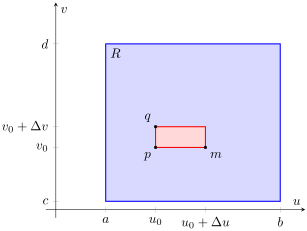
Let \(R\) be the region of the \(u\)-\(v\) plane bounded by \(a\leq u\leq b\text{,}\)\(c\leq v\leq d\) as shown in Figure 15.5.21(a). Partition \(R\) into rectangles of width \(\Delta u = \frac{b-a}n\) and height \(\Delta v = \frac{d-c}n\text{,}\) for some \(n\text{.}\) Let \(p=(u_0,v_0)\) be the lower left corner of some rectangle in the partition, and let \(m\) and \(q\) be neighboring corners as shown.
The point \(p\) maps to a point \(P = \vec r(u_0,v_0)\) on the surface \(\surfaceS\text{,}\) and the rectangle with corners \(p\text{,}\)\(m\) and \(q\) maps to some region (probably not rectangular) on the surface as shown in Figure 15.5.21(b), where \(M = \vec r(m)\) and \(Q = \vec r(q)\text{.}\) We wish to approximate the surface area of this mapped region.
Let \(\vec u = M-P\) and \(\vec v = Q-P\text{.}\) These two vectors form a parallelogram, illustrated in Figure 15.5.21(c), whose area approximates the surface area we seek. In this particular illustration, we can see that parallelogram does not particularly match well the region we wish to approximate, but that is acceptable; by increasing the number of partitions of \(R\text{,}\)\(\Delta u\) and \(\Delta v\) shrink and our approximations will become better.
A rectangle \(R\) is drawn and shaded in the first quadrant of the \(uv\) plane. Within the rectangle, points \(p\text{,}\)\(q\text{,}\) and \(m\) are marked. These points make up three of the four corners of a smaller subrectangle inside of \(R\text{.}\)
Along the \(u\) axis (the horizontal axis), there are points marked \(a\) and \(b\) corresponding to the left and right edges of \(R\text{.}\) Also marked is a point \(u_0\text{,}\) which is the \(u\) coordinate of both \(p\) and \(q\text{,}\) and a point \(u_0+\Delta u\text{,}\) which is the \(u\) coordinate of \(m\text{.}\)
Along the \(v\) axis (the vertical axis), points \(c\) and \(d\) are marked to indicate the top and bottom of \(R\text{.}\) Another point is marked with the value \(v_0\text{;}\) this is the \(v\) coordinate of both \(p\) and \(m\text{.}\) Also marked is a point with the value \(v_0+\Delta v\text{,}\) which is the \(v\) coordinate of \(q\text{.}\)
A smaller subrectangle is drawn inside of \(R\text{.}\) It has its bottom left vertex at \(p\text{,}\) with coordinates \((u_0,v_0)\text{,}\) and sides of length \(\Delta u\) and \(\Delta v\text{.}\)
A surface is drawn in space, relative to a set of three-dimensional coordinate axes. The precise shape of the surface is unimportant, but it appears to be a portion of an elliptic paraboloid, corresponding to the rectangular parameter domain \(R\) in Figure 15.5.21(a).
There are points on the surface marked \(P\text{,}\)\(Q\text{,}\) and \(M\text{,}\) corresponding to the points \(p\text{,}\)\(q\text{,}\) and \(m\) in the parameter domain. There is also a shaded patch on the surface, representing the portion that corresponds to the subrectangle drawn in Figure 15.5.21(a).
The sides of this patch are curved, since the surface is, but the patch is approximately rectangular. To emphasize this point, the image also shows the vectors \(\overrightarrow{PQ}\) (from \(P\) to \(Q\)) and \(\overrightarrow{PM}\) (from \(P\) to \(M\)). These vectors are straight line approximations of the corresponding sides of the patch on the surface.
This is a zoomed-in view of the patch illustrated in Figure 15.5.21(b). We see how the vectors \(\vec{u} = \overrightarrow{PQ}\) and \(\vec{v} = \overrightarrow{PM}\) form two sides of a parallelogram with one vertex at \(P\text{.}\)
This parallelogram overlaps with most (but not all) of the patch on the surface given by \(u_0\leq u\leq u_0+\Delta u\) and \(v_0\leq v\leq v_0+\Delta v\text{,}\) illustrating how the area of the parallelogram (which we know how to compute) is a good approximation of the area of the patch on the surface.
From Section 11.4 we know the area of this parallelogram is \(\snorm{\vec u\times \vec v}\text{.}\) If we repeat this approximation process for each rectangle in the partition of \(R\text{,}\) we can sum the areas of all the parallelograms to get an approximation of the surface area \(S\text{:}\)
\begin{equation*}
\text{ Surface area of } \surfaceS \, =S \approx \sum_{j=1}^n\sum_{i=1}^n \snorm{\vec u_{i,j}\times \vec v_{i,j}}\text{,}
\end{equation*}
where \(\vec u_{i,j} = \vec r(u_i+\Delta u,v_j) - \vec r(u_i,v_j)\) and \(\vec v_{i,j} = \vec r(u_i,v_j+\Delta v)-\vec r(u_i,v_j)\text{.}\)
From our previous calculus experience, we expect that taking a limit as \(n\to \infty\) will result in the exact surface area. However, the current form of the above double sum makes it difficult to realize what the result of that limit is. The following rewriting of the double summation will be helpful:
(This limit process also demonstrates that \(\vec r_u(u,v)\) and \(\vec r_v(u,v)\) are tangent to the surface \(\surfaceS\) at \(\vec r(u,v)\text{.}\) We don’t need this fact now, but it will be important in the next section.)
In Example 15.5.6, we parametrized the surface as \(\vec r(u,v) = \la 2v\cos(u), 2v\sin(u), 4v^2\cos^2u+8v^2\sin^2u\ra\text{,}\) for \(0\leq u\leq 2\pi\text{,}\)\(0\leq v\leq 1\text{.}\) To find the surface area using Theorem 15.5.22, we need \(\snorm{\vec r_u\times\vec r_v}\text{.}\) We find:
There is a lot of tedious work in the above calculations and the final integral is nontrivial. The use of a computer-algebra system is highly recommended.
In Section 15.1, we recalled the arc length differential \(ds=\snorm{\vrp(t)}dt\text{.}\) In subsequent sections, we used that differential, but in most applications the “\(\snorm{\vrp(t)}\)” part of the differential canceled out of the integrand (to our benefit, as integrating the square roots of functions is generally difficult). We will find a similar thing happens when we use the surface area differential \(dS\) in the following sections. That is, our main goal is not to be able to compute surface area; rather, surface area is a tool to obtain other quantities that are more important and useful. In our applications, we will use \(dS\text{,}\) but most of the time the “\(\snorm{\vec r_u\times \vec r_v}\)” part will cancel out of the integrand, making the subsequent integration easier to compute.
\(R\) is the ellipse with major axis of length 8 parallel to the \(x\)-axis, and minor axis of length 6 parallel to the \(y\)-axis, centered at the origin.
A surface \(\surfaceS\) in space is described that cannot be defined as the graph of a function \(f(x,y)\text{.}\) Give a parametrization of \(\surfaceS\text{.}\)
A set of three-dimensional coordinate axes are drawn, with the \(z\) axis pointing up. The domain \(D\) for this problem is a triangular prism. Cross-sections parallel to the \(xz\) plane are triangles, while cross-sections parallel to the other coordinate planes are rectangles.
Two other vertical faces are triangles. The triangle in the plane \(y=0\) has vertices \((1,0,0)\text{,}\)\((3,0,0)\text{,}\) and \((1,0,2)\text{.}\) The triangle in the plane \(y=2\) has vertices \((1,2,0)\text{,}\)\((3,2,0)\text{,}\) and \((3,2,2)\text{.}\)
The last face lies in the plane \(z=2x+4y-4\text{.}\) It meets the \(xy\) plane along the line from \((2,0,0)\) to \((0,1,0)\text{,}\) and has its remaining vertex at \((2,1,4)\text{.}\)
A cylindrical wedge, between the planes \(z=0\) and \(z=2y\text{.}\) These planes intersect along the \(x\) axis, forming the sharp edge of the wedge. The round face of the wedge is the parabolic cylinder \(y=4-x^2\text{,}\) for \(y\geq 0\text{.}\)
The last face is the parabolic cylinder. It is the portion of the cylinder \(y=4-x^2\) that lies above the plane \(z=0\) and below the plane \(z=2y\text{.}\)
Another part of the surface is the portion parabolic cylinder \(y=1-z^2\text{,}\) and the remaining face is the parabolic cylinder \(y=1-x^2\text{.}\) Both of these can be viewed as graphs over the \(xz\) plane. The surface \(y=1-z^2\) lies over the triangle bounded by \(x=z\text{,}\)\(x=0\text{,}\) and \(z=1\text{.}\) The surface \(y=1-x^2\) lies over the triangle bounded by \(x=z\text{,}\)\(x=1\text{,}\) and \(z=0\text{.}\)
This surface has three components. Two are faces in the planes \(z=1\) and \(z=3\text{.}\) Each of these is bounded by the ellipse \(x^2+y^2/9=1\text{.}\)
This surface has two components. One is the cone \(x^2+y^2=(z-1)^2\text{;}\) this is a circular cone; the vertex is at \((0,0,1)\text{,}\) and our surface is the part that opens downward.
The solid looks something like half of a seed. It is bounded above by the elliptic paraboloid \(z=4-x^2-4y^2\text{,}\) which opens downward from a vertex at \((0,0,4)\text{,}\) forming a sort of domed roof.
This paraboloid forms one component of the bounding surface for the solid. The other part is the elliptical disk formed when the surface meets the \(xy\) plane. It is the region in the \(xy\) plane that lies on and inside the ellipse \(x^2+4y^2=4\text{.}\)