An image of a general right cylinder. The area of the base of the cylinder is given to be \(A\text{.}\) The base of the cylinder resemembles a parallelogram with curved edges, with each side slightly bowing in at the half way point between two corners. The height of the cylinder is \(h\text{.}\) The base of the general cylinder is identical to the top of the general cylinder, with the two faces being parallel. These faces also coincide on top of eachother, which leads to right angles when the top and base are connected to form the general right cylinder. The volume of the general right cylinder is \(V=A\cdot h\text{.}\)
Given an arbitrary solid, we can approximate its volume by cutting it into \(n\) thin slices. When the slices are thin, each slice can be approximated well by a general right cylinder. Thus the volume of each slice is approximately its cross-sectional area × thickness. (These slices are the differential elements.)
By orienting a solid along the \(x\)-axis, we can let \(A(x_i)\) represent the cross-sectional area of the \(i\)th slice, and let \(\dx_i\) represent the thickness of this slice (the thickness is a small change in \(x\)). The total volume of the solid is approximately:
There are many ways to “orient” the pyramid along the \(x\)-axis; Figure 7.2.5 gives one such way, with the pointed top of the pyramid at the origin and the \(x\)-axis going through the center of the base.
Three-dimensional plot of a pyramid with a square base of side length \(10\) and height \(5\text{.}\) The peak of the pyramid is placed on the origin, from which it expands towards the positive \(x\)-axis. The square base of the pyramid is centered at the point \((5,0)\text{.}\) Additionally, the plot contains an arbitrarily chosen point labeled \(x\text{,}\) lying on the \(x\)-axis. Slicing the pyramid parallel to the base at this point \(x\) results in side lengths of the square slice to be \(2x\text{.}\)
Each cross section of the pyramid is a square; this is a sample differential element. To determine its area \(A(x)\text{,}\) we need to determine the side lengths of the square.
When \(x=5\text{,}\) the square has side length 10; when \(x=0\text{,}\) the square has side length 0. Since the edges of the pyramid are lines, it is easy to figure that each cross-sectional square has side length \(2x\text{,}\) giving \(A(x) = (2x)^2=4x^2\text{.}\)
If one were to cut a slice out of the pyramid at \(x=3\text{,}\) as shown in Figure 7.2.6, one would have a shape with square bottom and top with sloped sides. If the slice were thin, both the bottom and top squares would have sides lengths of about 6, and thus the cross-sectional area of the bottom and top would be about 36 in2. Letting \(\Delta x_i\) represent the thickness of the slice, the volume of this slice would then be about \(36\Delta x_i\) in3.
Three-dimensional plot of the same pyramid with a square base of side length \(10\) and height \(5\) as in the previous image. This time, the plot contains a thin slice of the pyramid at \(x=3\) which is parallel to the base of the pyramid. The side lengths of the resulting square slice are \(6\text{,}\) giving the square a surface area of \(36\) with an arbitrarily small thickness \(\Delta x\text{.}\)
Cutting the pyramid into \(n\) slices divides the total volume into \(n\) equally-spaced smaller pieces, each with volume \((2x_i)^2\Delta x\text{,}\) where \(x_i\) is the approximate location of the slice along the \(x\)-axis and \(\Delta x\) represents the thickness of each slice. One can approximate total volume of the pyramid by summing up the volumes of these slices:
Taking the limit as \(n\to\infty\) gives the actual volume of the pyramid; recoginizing this sum as a Riemann Sum allows us to find the exact answer using a definite integral, matching the definite integral given by Theorem 7.2.3.
We can check our work by consulting the general equation for the volume of a pyramid (a pyramid is a special type of cone — see Areas and Volumes in the back matter under “Volume of A General Cone”):
An important special case of Theorem 7.2.3 is when the solid is a solid of revolution, that is, when the solid is formed by rotating a shape around an axis.
Start with a function \(y=f(x)\) from \(x=a\) to \(x=b\text{.}\) Revolving this curve about a horizontal axis creates a three-dimensional solid whose cross sections are disks (thin circles). Let \(R(x)\) represent the radius of the cross-sectional disk at \(x\text{;}\) the area of this disk is \(\pi R(x)^2\text{.}\) Applying Theorem 7.2.3 gives the Disk Method.
Let a solid be formed by revolving the curve \(y=f(x)\) from \(x=a\) to \(x=b\) around a horizontal axis, and let \(R(x)\) be the radius of the cross-sectional disk at \(x\text{.}\) The volume of the solid is
\begin{equation*}
V = \pi \int_a^b R(x)^2\, dx\text{.}
\end{equation*}
A sketch can help us understand this problem. In Figure 7.2.9(a), the curve \(y=1/x\) is sketched along with the differential element — a disk — at \(x\) with radius \(R(x)=1/x\text{.}\) In Figure 7.2.9(b) the whole solid is pictured, along with the differential element.
The volume of the differential element shown in Figure 7.2.9(a) is approximately \(\pi R(x_i)^2\Delta x\text{,}\) where \(R(x_i)\) is the radius of the disk shown and \(\Delta x\) is the thickness of that slice. The radius \(R(x_i)\) is the distance from the \(x\)-axis to the curve, hence \(R(x_i) = 1/x_i\text{.}\)
Three-dimensional plot the curve \(y=1/x\) between \(x=1\) and \(x=2\) lying in the \(xy\) plane. The volume of the inside of the rotated curve is then approximated using thin circular disks. Taking an arbitrary circular disk, it would have a radius which whose length is equal to the distance between the \(x\)-axis and the curve \(y=1/x\text{.}\) The image depicts a circular disk centered at some arbitrary value of \(x\) between \(x=1\) and \(x=2\text{,}\) with the radius given by the function \(R(x)=1/x\text{.}\)
Three-dimensional plot the curve \(y=1/x\) between \(x=1\) and \(x=2\) lying in the \(xy\) plane. The curve is then rotated in a full circle about the \(x\)-axis. The solid is then bounded on both sides by the planes \(x=1/x\) and \(x=2/x\) which close off the solid with cirles of radius \(1\) and \(\frac12\) respectively. The volume of the inside of the curve is then approximated using thin circular disks which lie completely inside the solid as described in the previous image.
Taking the limit of the above sum as \(n\to\infty\) gives the actual volume; recognizing this sum as a Riemann sum allows us to evaluate the limit with a definite integral, which matches the formula given in Key Idea 7.2.7:
While Key Idea 7.2.7 is given in terms of functions of \(x\text{,}\) the principle involved can be applied to functions of \(y\) when the axis of rotation is vertical, not horizontal. We demonstrate this in the next example.
Since the axis of rotation is vertical, we need to convert the function into a function of \(y\) and convert the \(x\)-bounds to \(y\)-bounds. Since \(y=1/x\) defines the curve, we rewrite it as \(x=1/y\text{.}\) The bound \(x=1\) corresponds to the \(y\)-bound \(y=1\text{,}\) and the bound \(x=2\) corresponds to the \(y\)-bound \(y=1/2\text{.}\)
Thus we are rotating the curve \(x=1/y\text{,}\) from \(y=1/2\) to \(y=1\) about the \(y\)-axis to form a solid. The curve and sample differential element are sketched in Figure 7.2.11(a), with a full sketch of the solid in Figure 7.2.11(b).
Three-dimensional plot the curve \(y=1/x\) between \(x=1\) and \(x=2\) lying in the \(xy\) plane. The volume of the inside of the rotated curve is approximated thin horizontal circular disks. Taking an arbitrary circular disk, it would have a radius which whose length is equal to the distance between the \(y\)-axis and the curve \(x=1/y\text{.}\) The image depicts a circular disk centered at some arbitrary value of \(y\) between \(y=\frac12\) and \(y=1\text{,}\) with the radius given by the function \(R(y)=1/y\text{.}\)
Three-dimensional plot the curve \(y=1/x\) from \(x=1\) and \(x=2\) lying in the \(xy\) plane. The curve is then rotated in a full circle about the \(y\)-axis. The solid is then bounded on both the top and bottom by the planes \(y=1\) and \(y=\frac12\text{.}\) The plane \(y=1\) closes off the top of the solid with a circle of radius \(1\text{,}\) and the plane \(y=\frac12\) closes off the bottom of the solid with a circle of radius \(2\text{.}\) The volume of the inside of the curve is then approximated using thin circular disks which are contained completely inside the solid as described in the previous image.
We can also compute the volume of solids of revolution that have a hole in the center. The general principle is simple: compute the volume of the solid irrespective of the hole, then subtract the volume of the hole. If the outside radius of the solid is \(R(x)\) and the inside radius (defining the hole) is \(r(x)\text{,}\) then the volume is
Graph of two curves lying in the \(xy\) plane. One of the curves is blue and resembles the peak of a wave. The other curve is red, and resembles the trough of a wave. Both curves are plotted between the points \(a\) and \(b\) on the \(x\)-axis. For the interval \([a,b]\) the blue curve lies entirely above the red curve. Once the region between the blue and red curve is rotated about the \(y\)-axis, the blue curve which has a radius given by the function \(R(x)\) will be on the outside of the solid. The red curve will be on the inside of the solid, which will have a radius given by the function \(r(x)\text{.}\) Both the functions \(R(x)\) and \(r(x)\) give the distance of the curve from the axis of rotation, which in this case is some arbitrarily chosen line paralell and above the \(x\)-axis. The space on the inside of the red curve will then be completely empty once the region is rotated about the chosen axis of rotation.
Three dimensional graph of the region between the blue and red curves on the interval \([a,b]\) rotated about some line parallel and above \(x\)-axis. The outside of the solid is coloured blue, which resembles the blue curve which has a radius given by the function \(R(x)\) being rotated about the axis of rotation. The inside of the solid is coloured red, which resembles the red curve which has a radius by the function \(r(x)\) being rotated about the axis of rotation. The space on the inside of the red region is completely empty, which makes us subtract the outside radius \(R(x)\) from the inside radius \(r(x)\) to create washers which will approximate the volume of the solid.
One can generate a solid of revolution with a hole in the middle by revolving a region about an axis. Consider Figure 7.2.12(a), where a region is sketched along with a dashed, horizontal axis of rotation. By rotating the region about the axis, a solid is formed as sketched in Figure 7.2.12(b). The outside of the solid has radius \(R(x)\text{,}\) whereas the inside has radius \(r(x)\text{.}\) Each cross section of this solid will be a washer (a disk with a hole in the center) as sketched in Figure 7.2.13. This leads us to the Washer Method.
Three dimensional graph of the region between the blue and red curves on the interval \([a,b]\text{.}\) The graph also cotains a washer plotted on an arbitrary value of \(x\) in the interval \([a,b]\text{,}\) which will lie entirely inside the area between the blue and red curve. The outside of the washer has a radius of \(R(x)\text{,}\) while the inside of the washer has a radius of \(r(x)\text{.}\) In other words, the washer is a circle of radius \(R(x)\) with a circular hole of radius \(r(x)\) in the center. Taking these washers to be arbitrarily thin, we can calculate the volume of the solid which comes from rotating the region.
Let a region bounded by \(y=f(x)\text{,}\)\(y=g(x)\text{,}\)\(x=a\) and \(x=b\) be rotated about a horizontal axis that does not intersect the region, forming a solid. Each cross section at \(x\) will be a washer with outside radius \(R(x)\) and inside radius \(r(x)\text{.}\) The volume of the solid is
\begin{equation*}
V = \pi\int_a^b \Big(R(x)^2-r(x)^2\Big)\, dx\text{.}
\end{equation*}
A sketch of the region will help, as given in Figure 7.2.16(a). Rotating about the \(x\)-axis will produce cross sections in the shape of washers, as shown in Figure 7.2.16(b); the complete solid is shown in Figure 7.2.16(c). The outside radius of this washer is \(R(x) = 2x-1\text{;}\) the inside radius is \(r(x) = x^2-2x+2\text{.}\) As the region is bounded from \(x=1\) to \(x=3\text{,}\) we integrate as follows to compute the volume.
Graph of the region enclosed by the curves \(y=x^2-2x+2\) and \(y=2x-1\text{.}\) The curves which create an enclosed region both start at the point \((1,1)\) and end at the point \((3,5)\text{.}\) The line \(y=2x-1\) lies entirely above the curve \(y=x^2-2x+2\) for the entirety of the enclosed region. The radius of the outside of the washer is then given as distance between the \(x\)-axis and the line \(y=2x-1\text{,}\) and is given by the function \(R(x)=2x-1\text{.}\) The inside radius of the washer is given as the distance between the \(x\)-axis and the inside curve \(y=x^2-2x+2\text{,}\) and is given by the function \(r(x)=x^2-2x+2\text{.}\)
Graph of the region enclosed by the curves \(y=x^2-2x+2\) and \(y=2x-1\) with a washer centered at \(x=2\text{.}\) The washer lies parallel to the \(y\)-axis, and has an outside radius of \(R(2)=3\) and an inside radius of \(r(2)=2\text{.}\) In the original graph of the functions, \(R(2)=3\) is the distance between the line \(y=2x-1\) and the \(x\)-axis, and \(r(2)=2\) is the distance between the curve \(y=x^2-2x+2\) and the \(x\)-axis. The washer will lie entirely in the space enclosed by rotating the region between the two curves.
Three-dimensional graph of the space enclosed by rotating the curves \(y=x^2-2x+2\) and \(y=2x-1\) about the \(x\)-axis. The outside line \(y=2x-1\) forms the outer border of the solid once rotated about the \(x\)-axis, whose surface is coloured in blue. The inside curve \(y=x^2-2x+2\) forms the inner border of the solid once rotated about the \(x\)-axis, whose surface is coloured in red. The washers having outside radius \(R(x)=2x-1\) and inner radius \(r(x)=x^2-2x+2\) will lie entirely in the space enclosed by rotating the region between the two curves.
The triangular region is sketched in Figure 7.2.18(a); the differential element is sketched in Figure 7.2.18(b) and the full solid is drawn in Figure 7.2.18(c). They help us establish the outside and inside radii. Since the axis of rotation is vertical, each radius is a function of \(y\text{.}\)
The outside radius \(R(y)\) is formed by the line connecting \((2,1)\) and \((2,3)\text{;}\) it is a constant function, as regardless of the \(y\)-value the distance from the line to the axis of rotation is 2. Thus \(R(y)=2\text{.}\)
Graph of the triangular region with vertices at \((1,1)\text{,}\)\((2,1)\) and \((2,3)\text{.}\) As we are rotating about the \(y\)-axis, the outer radius is the outermost edge of the triangle, which is a horizontal line at \(x=2\text{,}\) giving us a constant \(R(y)=2\text{.}\) The inner radius is formed by the line between \((1,1)\) and \((2,3)\text{,}\) which is the line \(y=2x-1\text{.}\) This gives us an inner radius \(r(y)=\frac12(y+1)\text{.}\) The triangular region which we will rotate about the \(y\)-axis then consists of the area to the right of the line \(y=2x-1\) and to the left of the horizontal line \(x=2\) for \(1 \leq y \leq 3\text{.}\)
Graph of the triangular region with vertices at \((1,1)\text{,}\)\((2,1)\) and \((2,3)\) with a washer centered at \(y=2\text{.}\) The washer lies parallel to the \(x\)-axis, and has an outside radius of \(R(2)=2\) and an inside radius of \(r(2)=\frac32\text{.}\) In the original graph of the functions, \(R(2)=2\) is the distance between the rightmost edge of the triangular region and the \(y\)-axis. Similarly, \(r(2)=\frac32\) is the distance betweeen the leftmost edge of the triangular region given by the line \(y=2x-1\text{,}\) and the \(y\)-axis The washer will lie entirely in the space enclosed by rotating the region between the two curves as described in the following image.
Three-dimensional graph of the space enclosed by rotating the triangular region about the \(y\)-axis. The outside line \(x=2\) forms the outer border of the solid once rotated about the \(y\)-axis, whose surface is coloured in blue. The inside curve \(y=2x-1\text{,}\) or written in terms of \(y\) as \(x=\frac12(y+1)\) forms the inner border of the solid once rotated about the \(y\)-axis, whose surface is coloured in red. The washers having outside radius \(R(y)=2\) and inner radius \(r(y)=\frac12(y+1)\) will lie entirely in the space enclosed by rotating the region between the two curves and will allow us to calculate the volume of this solid.
The inside radius is formed by the line connecting \((1,1)\) and \((2,3)\text{.}\) The equation of this line is \(y=2x-1\text{,}\) but we need to refer to it as a function of \(y\text{.}\) Solving for \(x\) gives \(r(y) = \frac12(y+1)\text{.}\)
This section introduced a new application of the definite integral. Our default view of the definite integral is that it gives “the area under the curve.” However, we can establish definite integrals that represent other quantities; in this section, we computed volume.
The ultimate goal of this section is not to compute volumes of solids. That can be useful, but what is more useful is the understanding of this basic principle of integral calculus, outlined in Key Idea 7.0.1: to find the exact value of some quantity,
Explain the how the units of volume are found in the integral of Theorem 7.2.3: if \(A(x)\) has units of \(\text{in}^2\text{,}\) how does \(\int A(x)\,dx\) have units of \(\text{in}^3\text{?}\)
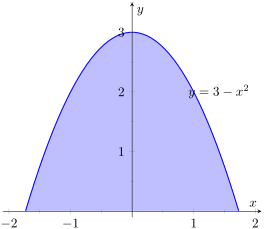
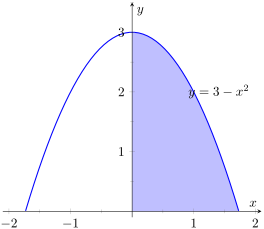
Graph of the region bounded by the curve \(y=3-x^2\) and the \(x\)-axis. The curve \(y=3-x^2\) begins at \(x\)-axis at the point \((-\sqrt{3},0)\text{.}\) From this point the curve rises until reaching the \(y\)-axis at the point \((0,3)\text{.}\) After reaching the \(y\)-axis, the curve slopes down until reaching the \(x\)-axis at the point \((\sqrt{3},0)\text{.}\) The region then contains the entire area below this curve, and above the \(x\)-axis.
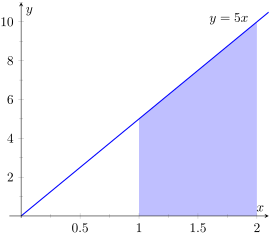
Graph of the region between \(y=5x\) and the \(x\)-axis, for \(1\leq x\leq 2\text{.}\) The line \(y=5x\) begins at the point \((1,5)\) from which it linearly increases until reaching the rightmost bound which is at the point \((2,10)\text{.}\) The region then contains the entire area below the line \(y=5x\) and above the \(x\)-axis for \(1\leq x\leq 2\text{.}\)
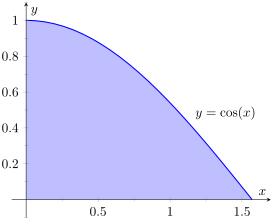
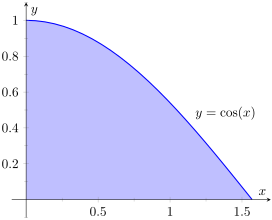
Graph of the region between \(y=\cos(x)\) and the \(x\)-axis, for \(0\leq x\leq \pi/2\text{.}\) The curve \(y=\cos(x)\) begins at the point \((0,1)\) from which it slopes downwards until ending after reaching the \(x\)-axis at the point \((\pi/2,0)\text{.}\) The region then contains the entire area below the curve \(y=\cos(x)\) and above the \(x\)-axis for \(0\leq x\leq \pi/2\text{.}\)
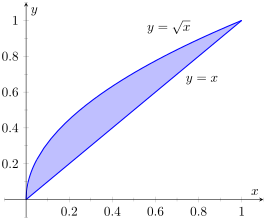
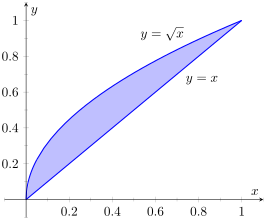
Graph of the region between the curves \(y=x\) and \(y=\sqrt{x}\text{.}\) The curves \(y=x\) and \(y=\sqrt{x}\) both begin at the origin. From this point the curve \(y=\sqrt{x}\) rises above the line \(y=x\) until reaching the point \((1,1)\text{,}\) where the curve once again intersects the line. The region then contains the area below the curve \(y=\sqrt{x}\) and above the line \(y=x\text{.}\)
Graph of the region bounded by the curve \(y=3-x^2\text{,}\) the \(x\)-axis, and the \(y\)-axis. Note that this region can reference both the regions to the left or right of the \(y\)-axis, but we will consider the region to the right of the \(y\)-axis. The curve \(y=3-x^2\) begins at the point \((0,3)\) from which it slopes down until reaching the \(x\)-axis. The region then contains the area to the right of the \(y\)-axis, and to the left of the curve \(y=3-x^2\) for \(y\) values between \(0\) and \(3\text{.}\)
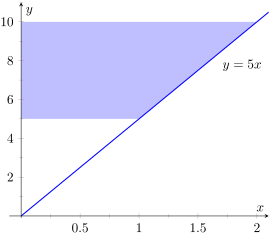
Graph of the region between \(y=5x\) and the \(y\) axis, for \(5\leq y\leq 10\text{.}\) The line \(y=5x\) begins at the point \((1,5)\text{,}\) from which it linearly increases until ending upper bound for \(y\) at the point \((2,10)\text{.}\) The region then contains the entire area to the right of \(x=0\) and to the left of the line \(y=5x\) for \(y\) between \(5\) and \(10\text{.}\)
Graph of the region between \(y=\cos(x)\) and the \(x\) axis, for \(0\leq x\leq \pi/2\text{.}\) The curve \(y=\cos(x)\) begins at the point \((0,1)\) from which it slopes downwards until ending after reaching the \(x\)-axis at the point \((\pi/2,0)\text{.}\) The region then contains the entire area to the right of \(x=0\) and to the left of of the curve \(y=\cos(x)\) for \(y\) values between \(0\) and \(1\text{.}\)
Graph of the region between the curves \(y=x\) and \(y=\sqrt{x}\text{.}\) The curves \(y=x\) and \(y=\sqrt{x}\) both begin at the origin. From this point the curve \(y=\sqrt{x}\) rises above the line \(y=x\) until reaching the point \((1,1)\text{,}\) where the curve once again intersects the line. The region consists of the area to the right of the curve \(y=\sqrt{x}\) and the to the left line \(y=x\) for \(y\) values between \(0\) and \(1\text{.}\)
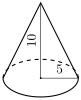
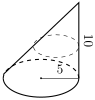
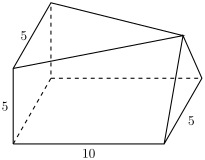
Orient the given solid along the \(x\)-axis such that a cross-sectional area function \(A(x)\) can be obtained, then apply Theorem 7.2.3 to find the volume of the solid.
Image of a right circular cone with height of 10 and base radius of 5. The base of the cone is a circle of radius 5. From the center of the circle to the peak of the cone we measure the height to be 10.
Image of a skew right circular cone with height of 10 and base radius of 5. The base of the cone is a circle of radius 5. From the rightmost edge of the circle to the peak of the cone we measure the height to be 10.
Image of a right triangular cone with height of 10 and whose base is a right isosceles triangle with side length 4. The base of the cone is a right isosceles triangle having two side lengths of 4. The two sides of length 4 are connected by a right angle. Additionally, the distance from the right angle occuring at the connection of the two sides of length 4 from the base of the triangle to the peak of the cone is measured to be 10.
A solid with length 10 with a rectangular base and triangular top, wherein one end is a square with side length 5 and the other end is a triangle with base and height of 5.
Image of a solid with length 10 with a rectangular base and triangular top, wherein one end is a square with side length 5 and the other end is a triangle with base and height of 5.. The rectangular base measures a length of 10 and a depth of 5. The square of side length 5 connects to the rectangle on the left side of the solid. The triangle with a base length and height of 5 connects to the rectangle on the right side of the solid. The square and triangle are then connected by two slanted trapezoidal regions on the front and back of the solid. On top of the solid is a triangle whose base of length 5 is connected to the square, having a height of 10.