Section 8.1 Equation of the Tangent Plane
We use what we learned about the partial derivatives and slopes of tangent lines to calculate the equation of the tangent plane to the surface \(z = f(x,y)\) at \(P_0(x_0, y_0, f(x_0,y_0))\text{.}\)
Let us consider the equation of the tangent plane \(A(x - x_0) + B(y - y_0) + C(z - z_0) = 0\text{,}\) where \(z_0 = f(x_0,y_0)\text{.}\) We then rewrite the equation as
\begin{equation}
z - z_0 = -\frac{A}{C}(x - x_0) - \frac{B}{C}(y - y_0).\tag{8.1}
\end{equation}
When \(y = y_0\text{,}\) we have \(z - z_0 = -\frac{A}{C}(x - x_0)\text{,}\) which is the equation of the tangent line at \(P_0\) in the plane \(y = y_0\text{,}\) and therefore its slope \(-\frac{A}{C}\) is \(f_x(x_0,y_0)\text{.}\) Similarly, when \(x = x_0\text{,}\) we have \(z - z_0 = -\frac{B}{C}(y - y_0)\text{,}\) which is the equation of the tangent line at \(P_0\) in the plane \(x = x_0\text{,}\) and therefore its slope \(-\frac{B}{C}\) is \(f_y(x_0,y_0)\text{.}\) Figure 8.1 shows the two tangent lines inside the planes \(y = y_0\) and \(x = x_0\text{.}\)
Therefore the equation of the tangent plane to the surface \(z = f(x,y)\) at \(P_0(x_0, y_0, f(x_0,y_0))\) is
\begin{equation}
f_x(x_0,y_0)(x - x_0) + f_y(x_0,y_0)(y - y_0) - (z - z_0) = 0.\tag{8.2}
\end{equation}
Note that we can write the equation of the surface as \(w(x,y,z) = f(x,y) - z = 0\) and define the gradient of \(w\) as
\begin{equation*}
\nabla w = \left(\frac{\partial w}{\partial x}\right)\mathbf i
+ \left(\frac{\partial w}{\partial y}\right)\mathbf j
+ \left(\frac{\partial w}{\partial z}\right)\mathbf k.
\end{equation*}
Then, reading off the coefficients in (8.2), the normal vector to the tangent plane is
\begin{equation}
\mathbf n = \nabla w \Big|_{P_0}
= f_x(x_0,y_0)\,\mathbf i + f_y(x_0,y_0)\,\mathbf j - \mathbf k.\tag{8.3}
\end{equation}
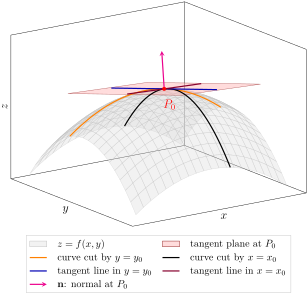
A gray dome-shaped surface, the graph of z equals f of x y, with the pink tangent plane touching it at the red point P 0. The orange curve cut by the plane y equals y 0 and the black curve cut by the plane x equals x 0 run across the surface through P 0. The blue tangent line to the orange curve at P 0 and the dark red tangent line to the black curve at P 0 lie inside the tangent plane, and a magenta arrow, the normal vector n, points away from the plane at P 0, perpendicular to both tangent lines. A legend below the figure names each of these seven elements.
Everything in the figure above can also be explored interactively in the Tangent Plane Explorer, which opens in a new tab. It builds the picture up one layer at a time — the surface, the point \(P_0\text{,}\) the two cutting planes and the curves they cut, the two tangent lines, the tangent plane, and finally \(\mathbf n\) — for any of several surfaces. Drag \(P_0\) around and rotate the figure to see for yourself that the tangent plane always contains both tangent lines and that \(\mathbf n\) always stands at a right angle to it.
Also, note that \(\mathbf n = \nabla w \Big|_{P_0}\) is the direction vector of the line normal to the surface at \(P_0(x_0, y_0, f(x_0,y_0))\text{,}\) which means the parametric equations of the normal line to the surface at \(P_0\) are
\begin{align}
x(t) \amp= x_0 + f_x(x_0,y_0)\,t\tag{8.4}\\
y(t) \amp= y_0 + f_y(x_0,y_0)\,t\tag{8.5}\\
z(t) \amp= f(x_0,y_0) - t\tag{8.6}\\
t \amp\in \R.\tag{8.7}
\end{align}
You have attempted of activities on this page.

