
Worksheet 11.6 Exercises for Lagrange Multipliers

If you would like to review this topic before attempting the exercises, click Lagrange Multipliers.

1. Tangent Planes Parallel to a Given Plane.

Find the points on the surface
\begin{equation*} x^2 + y^2 + 3z^2 = 1 \end{equation*}
at which the tangent plane is parallel to the plane \(-x - 5y - 2z = -3\text{.}\)
Solution.
Multiplying by \(-1\text{,}\) the given plane is \(x + 5y + 2z = 3\text{,}\) with normal vector \(\mathbf{n} = \langle 1, 5, 2\rangle\text{.}\) The tangent plane to the ellipsoid is parallel to this plane exactly at the points of the ellipsoid that are closest to and farthest from it, so we minimize and maximize the distance to the plane subject to the constraint of lying on the ellipsoid.
Diagram Exploration Keyboard Controls
Key Action
Enter, A Activate keyboard driven exploration
B Activate menu driven exploration
Escape Leave exploration mode
Cursor down Explore next lower level
Cursor up Explore next upper level
Cursor right Explore next element on level
Cursor left Explore previous element on level
X Toggle expert mode
W Extra details if available
Space Repeat speech
M Activate step magnification
Comma Activate direct magnification
N Deactivate magnification
Z Toggle subtitles
C Cycle contrast settings
T Monochrome colours
L Toggle language (if available)
K Kill current sound
Y Stop sound output
O Start and stop sonification
P Repeat sonification output
Figure 11.6. A schematic cross-section. The tangent plane to the ellipsoid is parallel to the given plane exactly at the closest point \(S_1\) and the farthest point \(S_2\text{,}\) where \(\nabla g\) is parallel to the plane’s normal \(\mathbf{n}\text{.}\)
Choose a point on the plane, say \(P(3,0,0)\text{.}\) For a point \(S(x,y,z)\) on the ellipsoid, the distance from \(S\) to the plane is
\begin{equation*} \frac{\overrightarrow{PS}\cdot\mathbf{n}}{\lvert\mathbf{n}\rvert} = \frac{\langle x-3,\, y,\, z\rangle\cdot\langle 1,5,2\rangle} {\lvert\mathbf{n}\rvert}. \end{equation*}
Since \(\lvert\mathbf{n}\rvert\) is constant, it suffices to optimize the numerator
\begin{equation*} f(x,y,z) = x - 3 + 5y + 2z \end{equation*}
subject to the constraint
\begin{equation*} g(x,y,z) = x^2 + y^2 + 3z^2 - 1 = 0. \end{equation*}
The Lagrange condition \(\nabla f = \lambda\, \nabla g\) gives
\begin{equation*} \langle 1, 5, 2\rangle = \lambda \langle 2x,\, 2y,\, 6z\rangle, \end{equation*}
so
\begin{equation*} x = \frac{1}{2\lambda}, \qquad y = \frac{5}{2\lambda}, \qquad z = \frac{1}{3\lambda}. \end{equation*}
Substituting into the constraint \(x^2 + y^2 + 3z^2 = 1\text{,}\)
\begin{align*} \frac{1}{4\lambda^2} + \frac{25}{4\lambda^2} + \frac{3}{9\lambda^2} \amp= 1\\ \frac{3 + 75 + 4}{12\lambda^2} \amp= 1\\ \frac{1}{\lambda^2} \amp= \frac{12}{82}, \end{align*}
so that
\begin{equation*} \frac{1}{\lambda} = \pm 2\sqrt{\frac{3}{82}}. \end{equation*}
Therefore
\begin{equation*} x = \pm\sqrt{\frac{3}{82}}, \qquad y = \pm 5\sqrt{\frac{3}{82}}, \qquad z = \pm\sqrt{\frac{2}{123}}, \end{equation*}
and the two points are
\begin{equation*} S_1\!\left(\sqrt{\tfrac{3}{82}},\; 5\sqrt{\tfrac{3}{82}},\; \sqrt{\tfrac{2}{123}}\right) \qquad\text{and}\qquad S_2\!\left(-\sqrt{\tfrac{3}{82}},\; -5\sqrt{\tfrac{3}{82}},\; -\sqrt{\tfrac{2}{123}}\right). \end{equation*}
The positive signs give \(S_1\text{,}\) the point closest to the plane, and the negative signs give \(S_2\text{,}\) the farthest. At both points the tangent plane is parallel to the plane \(x + 5y + 2z = 3\text{.}\)

2. A product on a circle.

Find the maximum and minimum values of the function \(f(x,y) = 4xy\) subject to the constraint \(x^2 + y^2 = 8\text{.}\)
Solution.
Write the constraint as
\begin{equation*} g(x,y) = x^2 + y^2 - 8 = 0, \end{equation*}
so that \(g_x = 2x\) and \(g_y = 2y\text{,}\) while \(f_x = 4y\) and \(f_y = 4x\text{.}\) The Lagrange condition \(\nabla f = \lambda\,\nabla g\) gives
\begin{equation*} 4y = 2\lambda x, \qquad 4x = 2\lambda y. \end{equation*}
Solving each equation for \(\lambda\text{,}\)
\begin{equation*} \lambda = \frac{2y}{x} = \frac{2x}{y} \qquad\Longrightarrow\qquad x^2 = y^2. \end{equation*}
Substituting into the constraint \(x^2 + y^2 - 8 = 0\) gives \(2x^2 = 8\text{,}\) so
\begin{equation*} x = \pm 2, \qquad y = \pm 2. \end{equation*}
Hence there are four extrema: \((2,2)\text{,}\) \((2,-2)\text{,}\) \((-2,2)\text{,}\) \((-2,-2)\text{.}\)
Evaluating \(f\) at the four candidates:
\((x,y)\) \(f(x,y)\)
\((2,2)\) \(16\)
\((-2,-2)\) \(16\)
\((2,-2)\) \(-16\)
\((-2,2)\) \(-16\)
The maximum value is \(16\text{,}\) attained at \((2,2)\) and \((-2,-2)\text{;}\) the minimum value is \(-16\text{,}\) attained at \((2,-2)\) and \((-2,2)\text{.}\)
Geometric interpretation. A rectangle with corners \((\pm x, \pm y)\) inscribed in the circle \(x^2+y^2=8\) has area exactly \(4xy = f(x,y)\text{.}\) As the corner \((x,y)\) moves along the circle, we obtain rectangles of different areas.
Diagram Exploration Keyboard Controls
Key Action
Enter, A Activate keyboard driven exploration
B Activate menu driven exploration
Escape Leave exploration mode
Cursor down Explore next lower level
Cursor up Explore next upper level
Cursor right Explore next element on level
Cursor left Explore previous element on level
X Toggle expert mode
W Extra details if available
Space Repeat speech
M Activate step magnification
Comma Activate direct magnification
N Deactivate magnification
Z Toggle subtitles
C Cycle contrast settings
T Monochrome colours
L Toggle language (if available)
K Kill current sound
Y Stop sound output
O Start and stop sonification
P Repeat sonification output
Figure 11.7. Some of the possible rectangles inscribed in the circle \(x^2+y^2=8\text{.}\) Each has corners \((\pm x, \pm y)\) for a point \((x,y)\) on the circle, and therefore area \(4xy = f(x,y)\text{.}\)
The values of \((x,y)\) that maximize \(f\) are exactly the values that maximize the area of the inscribed rectangle.
Diagram Exploration Keyboard Controls
Key Action
Enter, A Activate keyboard driven exploration
B Activate menu driven exploration
Escape Leave exploration mode
Cursor down Explore next lower level
Cursor up Explore next upper level
Cursor right Explore next element on level
Cursor left Explore previous element on level
X Toggle expert mode
W Extra details if available
Space Repeat speech
M Activate step magnification
Comma Activate direct magnification
N Deactivate magnification
Z Toggle subtitles
C Cycle contrast settings
T Monochrome colours
L Toggle language (if available)
K Kill current sound
Y Stop sound output
O Start and stop sonification
P Repeat sonification output
Figure 11.8. The optimal solution: the inscribed rectangle with corners \((\pm 2, \pm 2)\text{,}\) whose area \(4xy = f(2,2) = 16\) is the largest possible.

3. Maximizing a Cobb-Douglas utility.

A consumer has $600 to spend on two commodities, the first of which costs $20 per unit and the second $30 per unit. Suppose that the utility derived by the consumer from \(x\) units of the first commodity and \(y\) units of the second commodity is given by the Cobb-Douglas utility function
\begin{equation*} U(x,y) = 10\,x^{0.6}y^{0.4}. \end{equation*}
How many units of each commodity should the consumer buy to maximize utility?
Solution.
The budget constraint is \(20x + 30y = 600\text{,}\) so we take
\begin{equation*} g(x,y) = 20x + 30y - 600 = 0, \end{equation*}
with \(g_x = 20\) and \(g_y = 30\text{,}\) and maximize \(U(x,y) = 10\,x^{0.6}y^{0.4}\text{,}\) whose partial derivatives are
\begin{equation*} U_x = 6\,x^{-0.4}y^{0.4}, \qquad U_y = 4\,x^{0.6}y^{-0.6}. \end{equation*}
The Lagrange condition \(\nabla U = \lambda\,\nabla g\) gives the system
\begin{equation*} 6\,x^{-0.4}y^{0.4} = 20\lambda, \qquad 4\,x^{0.6}y^{-0.6} = 30\lambda. \end{equation*}
Dividing the first equation by the second eliminates \(\lambda\text{:}\)
\begin{equation*} \frac{3}{2}\cdot\frac{y}{x} = \frac{2}{3} \qquad\Longrightarrow\qquad y = \frac{4}{9}\,x. \end{equation*}
Substituting into the budget constraint,
\begin{align*} 20x + 30\left(\frac{4}{9}x\right) \amp= 600\\ 20x + \frac{40}{3}x \amp= 600\\ \frac{100}{3}x \amp= 600, \end{align*}
so \(x = 18\) and \(y = 18\cdot\frac{4}{9} = 8\text{.}\) The consumer should buy \(18\) units of the first commodity and \(8\) units of the second.

4. Minimizing the cost of a box.

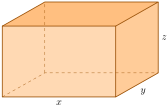
A jewelry box is to be constructed of material that costs $1 per square inch for the bottom, $2 per square inch for the sides, and $5 per square inch for the top. If the total volume is to be \(96 \text{ in}^3\text{,}\) what dimensions will minimize the total cost of construction?
A rectangular box drawn in three dimensions, with the horizontal edges of the base labeled x and y and the vertical edge labeled z.
Figure 11.9. The box with dimensions \(x\text{,}\) \(y\text{,}\) \(z\text{:}\) bottom and top of area \(xy\text{,}\) and sides of areas \(xz\) and \(yz\text{.}\)
Solution.
Let \(x\) and \(y\) be the dimensions of the base and \(z\) the height. The bottom costs \(1\cdot xy\text{,}\) the top costs \(5\cdot xy\text{,}\) and the four sides cost \(2(2xz) + 2(2yz)\text{,}\) so the total cost of construction is
\begin{equation*} C(x,y,z) = 6xy + 4xz + 4yz, \end{equation*}
with partial derivatives
\begin{equation*} C_x = 6y + 4z, \qquad C_y = 6x + 4z, \qquad C_z = 4x + 4y. \end{equation*}
The volume requirement gives the constraint
\begin{equation*} g(x,y,z) = xyz - 96 = 0, \end{equation*}
with \(g_x = yz\text{,}\) \(g_y = xz\text{,}\) \(g_z = xy\text{.}\)
The Lagrange condition \(\nabla C = \lambda\,\nabla g\) gives the system
\begin{equation*} 6y + 4z = \lambda yz, \qquad 6x + 4z = \lambda xz, \qquad 4x + 4y = \lambda xy. \end{equation*}
Multiplying the equations by \(x\text{,}\) \(y\text{,}\) \(z\) respectively makes each right-hand side equal to \(\lambda xyz\text{:}\)
\begin{equation*} 6xy + 4xz = 6xy + 4yz = 4xz + 4yz. \end{equation*}
The first equality gives \(4xz = 4yz\text{,}\) so \(x = y\text{.}\) The second gives \(6xy = 4xz\text{,}\) so \(z = \frac{3}{2}y\text{.}\)
Substituting \(y = x\) and \(z = \frac{3}{2}x\) into the constraint \(xyz = 96\text{,}\)
\begin{equation*} (x)(x)\left(\tfrac{3}{2}x\right) = 96 \qquad\Longrightarrow\qquad x^3 = 64, \end{equation*}
so \(x = 4\text{.}\) The cost is minimized by the dimensions
\begin{equation*} x = 4, \qquad y = 4, \qquad z = 6. \end{equation*}
You have attempted of activities on this page.
